
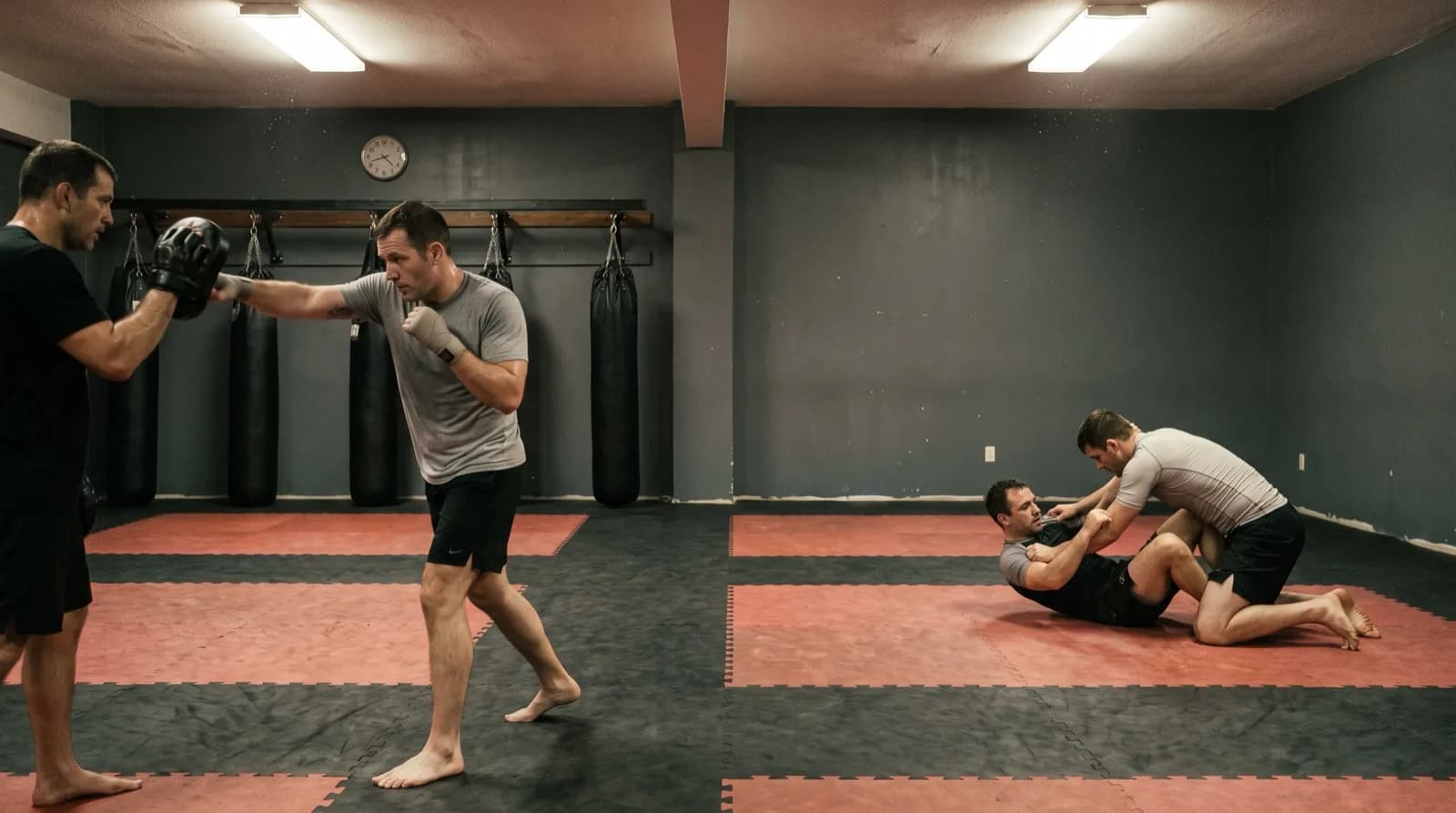
Quick answer. Try Muay Thai first if you want to learn to punch, kick, and move on your feet. Try Brazilian jiu-jitsu (BJJ) first if you’d rather learn to control a position or escape from one with a partner on the mat. If both sound good, pick the beginner class you can get to regularly. Afterward, ask yourself which drill you’d like another shot at.
Do I have to spar or roll in my first class?
It depends on the gym and the class. Pad work and coached partner drills give you a set move to practice. Sparring in Muay Thai and rolling in BJJ are live rounds where you react to what your partner does in the moment. Before you book, ask if beginners join those rounds and whether you can watch or stick with drills on your first day.
Muay Thai and BJJ side by side
| Muay Thai | Brazilian jiu-jitsu | |
|---|---|---|
| Main skill | Striking and managing distance on your feet | Grappling and working through positions on the mat |
| A drill you might try | Throw a kick into a pad, then get back into your stance | Practice getting out from under a partner who’s holding you in place |
| Partner contact | Holding pads, practicing with a partner, or working up close in the clinch | Close contact as you practice holding positions and escaping |
What you’ll practice in Muay Thai
Muay Thai is a striking art from Thailand. It’s called the art of eight limbs because it uses punches, elbows, knees, and kicks. It also includes the clinch, where you work with a partner at close range while standing.
Early on, a simple drill might have you step into range, kick a pad, and reset your feet. The pad gives you a target, and the reset helps you see whether you stayed balanced. If you like the idea of getting that sequence a little smoother each time, take a look at Kaizen’s Muay Thai classes.
What you’ll practice in Brazilian jiu-jitsu
BJJ is a grappling art where much of the practice happens on the ground. You learn how to hold a position, move to a better one, and escape when someone has you pinned. As you progress, you also learn submissions, where a partner taps to signal you to stop.
In an escape drill, a coach might show you how to turn onto your side and move your hips to make room. You can feel how a small change in position gives you space to move again. If that kind of problem-solving sounds fun and you’re comfortable working up close, explore Kaizen’s BJJ classes.
How to tell if a trial class is a good fit
- Find out what gear you need. Tell the coach it’s your first time and ask what to wear and bring.
- See how the coach helps you when you get stuck. Can you follow the demo? When you lose your balance or can’t make space to move, do you get a correction you can try on the next rep? Pay attention to whether the coach and your partner give you time to try it again.
- Notice what you want to practice again. A drill can feel awkward and still make you want another go. If you’re still torn, check whether you can try the other class and use the same questions to compare them.
Is Muay Thai or BJJ harder to learn?
It depends on which movements are new to you. In Muay Thai, a punch and a kick might feel straightforward on their own. Putting them together while keeping your stance can take practice. In BJJ, you might follow an escape when the coach shows it, then have to work out which way to turn when you’re underneath your partner.
Choose a Northern Virginia location to see which classes you can try.