
Most parents who call us about a self-defense class for their teenager are picturing the same thing: their kid learning a few moves that would let them get away if someone grabbed them at a party, a bus stop, or walking home. It's a good instinct, and self-defense is one of the most common reasons a teen starts training with us. But the version most people imagine, a quick course full of dramatic escapes, is mostly not the thing that keeps a teenager safe.
I've coached self-defense in Northern Virginia for over twenty years, a lot of it with teenagers and their nervous parents. So here's the honest version: what real self-defense for a teen actually is, the skills that hold up when it counts, the stuff that sounds great and fails, and how a teen with zero experience starts. This piece pairs with our broader guide on martial arts for teens, which covers the confidence and fitness side.
Quick answer: do self-defense classes actually work for teens?
Yes, when they teach the right thing. Real self-defense for a teenager is about eighty percent awareness and decision-making, and twenty percent physical skill. The most valuable thing we teach a teen is boring: read a situation early, keep distance, don't escalate, and leave before anything happens. The physical piece matters as a last resort, and the skills that genuinely work under pressure are grappling and basic striking trained live, not a set of memorized moves. What doesn't work is a one-weekend seminar that sells a teen the feeling of being untouchable. That feeling is more dangerous than useful, because it pushes a kid toward a situation they should have walked away from.
What real self-defense for a teenager is mostly about
The fights a teenager is most likely to face are the ones they see coming: a heated moment at school, a group getting aggressive, a stranger who feels off. Almost all of those are avoidable if a teen reads the room early and makes the boring choice. So that's where we start. We teach teens to notice when a situation is tilting, to keep their distance and their hands free, to not get baited into a back-and-forth, and to leave without needing to win the argument. None of that looks impressive, and all of it works far more often than any technique.
The reason this matters so much for teens specifically is that the pull to stand your ground is strongest at that age. A 15 year old doesn't want to look scared in front of friends, so they stay in a bad spot longer than an adult would. The single most useful skill we can build is the confidence to walk away, which is a strange thing to teach in a gym full of mats and bags, but it's the real work.
The self-defense skills that actually hold up for a teen
When avoidance isn't an option and someone has their hands on a teen, the physical skill has to survive contact with a person who is bigger and actually trying. That rules a lot of things out. What survives is simple: create space, break a grip, control the distance, and get away. We drill escapes from grabs and holds, how to protect your head, and how to use position and leverage rather than raw strength, because a teenager is often smaller than whoever they're dealing with.
These get trained the same way everything at a real gym gets trained: live, with a resisting partner, at a pace that's safe. That's the difference between a skill and a party trick. A teen who has broken a grip a hundred times against someone actually holding on will do it under stress. A teen who watched it once in a seminar will freeze. Our guide to the best martial arts for self-defense breaks down which disciplines hold up for exactly this reason.
What to skip: the self-defense that sounds good and fails
Some of the most popular self-defense content is the least useful, and it's worth a parent knowing what to be skeptical of before paying for it. The honest test for any technique is simple: would it work against someone bigger who is actively trying to stop you? Most of the flashy stuff fails that test the moment the other person stops cooperating.
- One-weekend self-defense seminars. You can't build a real skill in a few hours. A teen leaves with confidence but not capability, which is the worst combination.
- Pressure-point and nerve strikes. They look dramatic in a demo and don't stop a determined person.
- Choreographed weapon disarms. The angles a real situation gives you are never the clean angles you drilled.
- Anything that trains a teen to engage rather than leave. The goal is to get away, not to win.
Situation to skill: what actually helps
Here's the honest mapping of what a teen is likely to run into and what genuinely helps in each case.
| The situation | What actually helps |
|---|---|
| A moment at school starts to heat up | Reading it early, keeping distance, not escalating, walking away |
| A group gets aggressive | Awareness, leaving before it forms up, not getting isolated |
| Someone grabs a wrist or clothing | A drilled grip-break and creating space, trained live |
| A teen ends up on the ground | Position and leverage from grappling, protect the head, get up and away |
| A stranger who feels off | Trusting the instinct, distance, moving toward people and exits |
Why grappling is the most useful physical piece for a teen
If a teen is only going to train one physical skill for self-defense, grappling is the one I'd pick, and Brazilian jiu jitsu in particular. Two reasons. First, it lets a smaller person control a bigger one using position and leverage instead of strength, which is exactly the situation a teenager is usually in. Second, and this is underrated, grappling lets a teen control a situation without throwing a punch. That keeps them safer legally and physically, because they can neutralize a shove or a grab without escalating to strikes that get everyone hurt and get the teen in trouble. If you want the fuller picture of how grappling works for a beginner, our guide to BJJ for beginners walks through it.
Self-defense for teen girls specifically
Parents of teenage daughters ask about self-defense more than anyone, and the honest answer is that the same skills apply, with grappling being an even better fit. A teen girl who learns to control distance and escape grabs against bigger training partners builds something a seminar can't give her: the lived experience of handling herself in a physical situation. That changes how she carries herself, and that carry is itself a deterrent. We make sure a new teen girl is paired well and never thrown into a mismatch. Much of what we teach overlaps with our adult women's self-defense classes, scaled for a teenager.
What a self-defense-focused class looks like at Kaizen
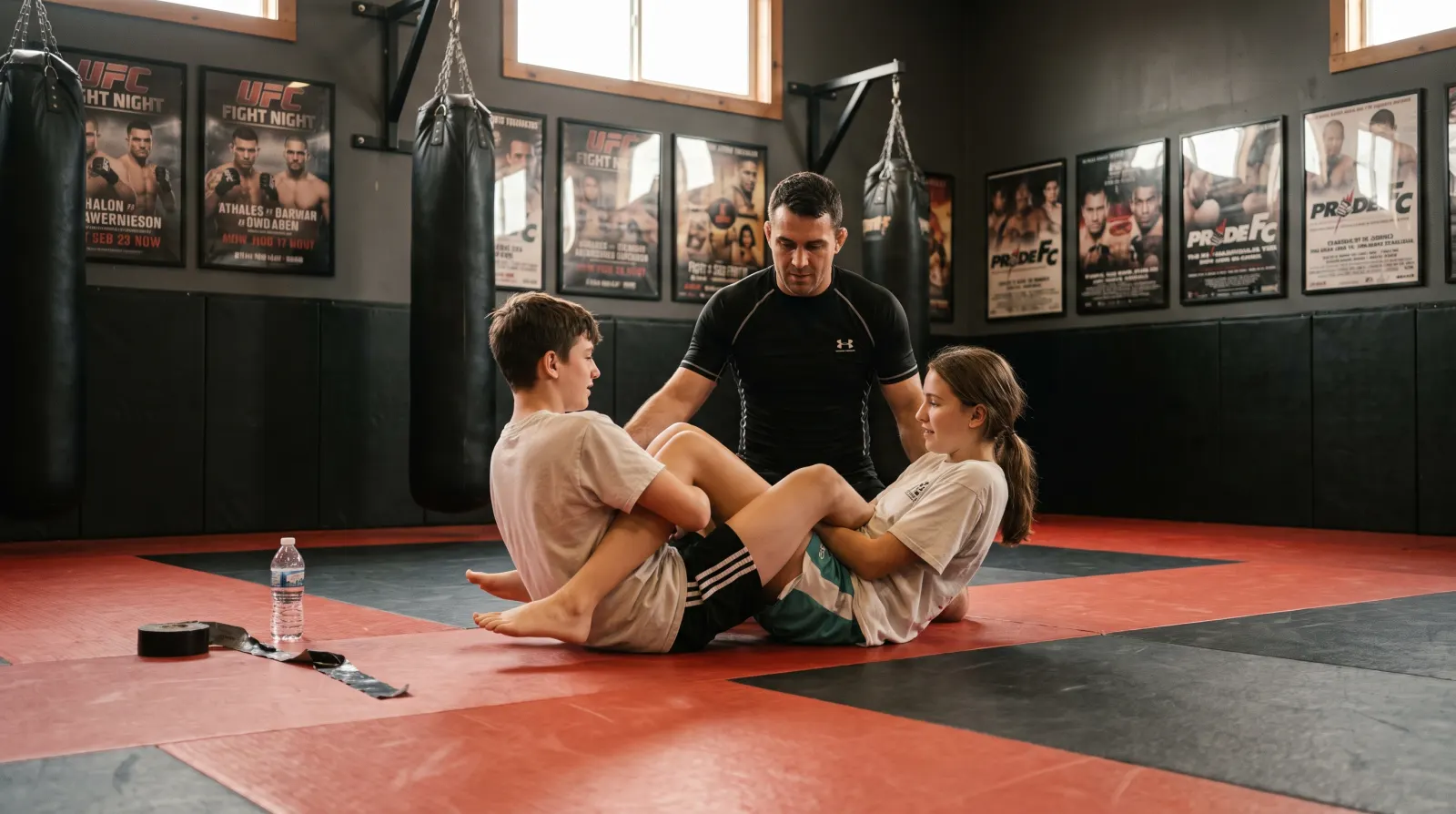
We don't run a separate "self-defense course" that's walled off from real training, because the honest truth is that consistent martial arts training is the self-defense. A teen who trains grappling and striking a couple times a week for a few months is far safer than one who took a dedicated self-defense weekend, and it isn't close. So a teen's self-defense really looks like showing up to regular classes, drilling escapes and position and basic striking with resisting partners, and building the awareness and calm that come from being comfortable in a physical situation. It's less dramatic than parents expect and much more effective. It also builds the confidence and steadiness we cover in our piece on confidence and bullying.
Starting as a teen with no experience
Almost every teen who walks in for self-defense has never trained, and that's completely normal. Nobody expects a 15 year old to know anything on day one, and a beginner class is the least intimidating place to start. The first weeks are about learning the shape of a class and picking up basics with no pressure to be good, and beginners don't spar hard for a long time, so a teen and a parent can both drop the fear of getting hurt early. If your teen is anxious about the first class, our walkthrough of what to expect in a first class lays out exactly what the hour feels like.
The honest next step
The best way to know if it fits your teenager is to let them try a class, not to decide from a website. Come watch, or better, have them get on the mat for a free session and feel it out. We run teen programs and self-defense training across our Northern Virginia academies, from Falls Church and Fairfax to Vienna, Ashburn, and Purcellville, so there's usually a location and a schedule that fits around school. Take a look at the class schedule to see what times work.
When you're ready, book a free trial at the location nearest you and mention it's a teen coming in for self-defense, since it helps us place them in the right class and partner them well.
Frequently asked questions about self-defense classes for teens
Do self-defense classes actually work for teenagers?
Yes, when they teach the right thing. Real self-defense for a teen is mostly awareness and good decisions, and a smaller share physical skill. The physical skills that hold up are grappling and basic striking trained live against a resisting partner, not memorized moves. A one-weekend seminar mostly sells confidence, not capability, which can push a teen toward a situation they should have left.
What is the best self-defense for a teen to learn?
Grappling, and Brazilian jiu jitsu in particular. It lets a smaller teen control a bigger person using position and leverage instead of strength, and it lets them neutralize a grab or shove without throwing a punch, which keeps them safer physically and legally. Basic boxing footwork and distance help too. Any of it only works if it's trained live over time, not learned in one session.
Is a weekend self-defense seminar enough for my teen?
Not really. You can't build a real skill in a few hours, so a teen leaves a seminar with confidence but not capability, which is the worst mix. Consistent training a couple times a week for a few months makes a teenager far safer than any one-off course. The seminar can be a fine introduction, but treat it as a taste, not the training.
Will self-defense training make my teen more aggressive?
No, the opposite is what we see. A teen who trains almost always gets calmer, because they no longer feel they have anything to prove. We coach hard for the difference between confident and aggressive, and the whole goal of self-defense is to avoid and leave a bad situation, not to win it. Teens who train tend to walk away from trouble more, not less.
Can my teenage daughter learn self-defense here?
Yes, and grappling suits her especially well because it rewards technique and leverage over size. A teen girl who learns to control distance and escape grabs against bigger partners builds real, lived confidence that a seminar can't give her. We pair a new teen girl carefully and never throw her into a mismatch, and many of our locations have women and teen girls training every session.
Kaizen MMA runs teen self-defense and martial arts programs across Northern Virginia in Falls Church, Fairfax, Vienna, Ashburn, and Purcellville. Book a free trial class at the location nearest you, and mention it's a teen coming in for self-defense so we can place them in the right class.