
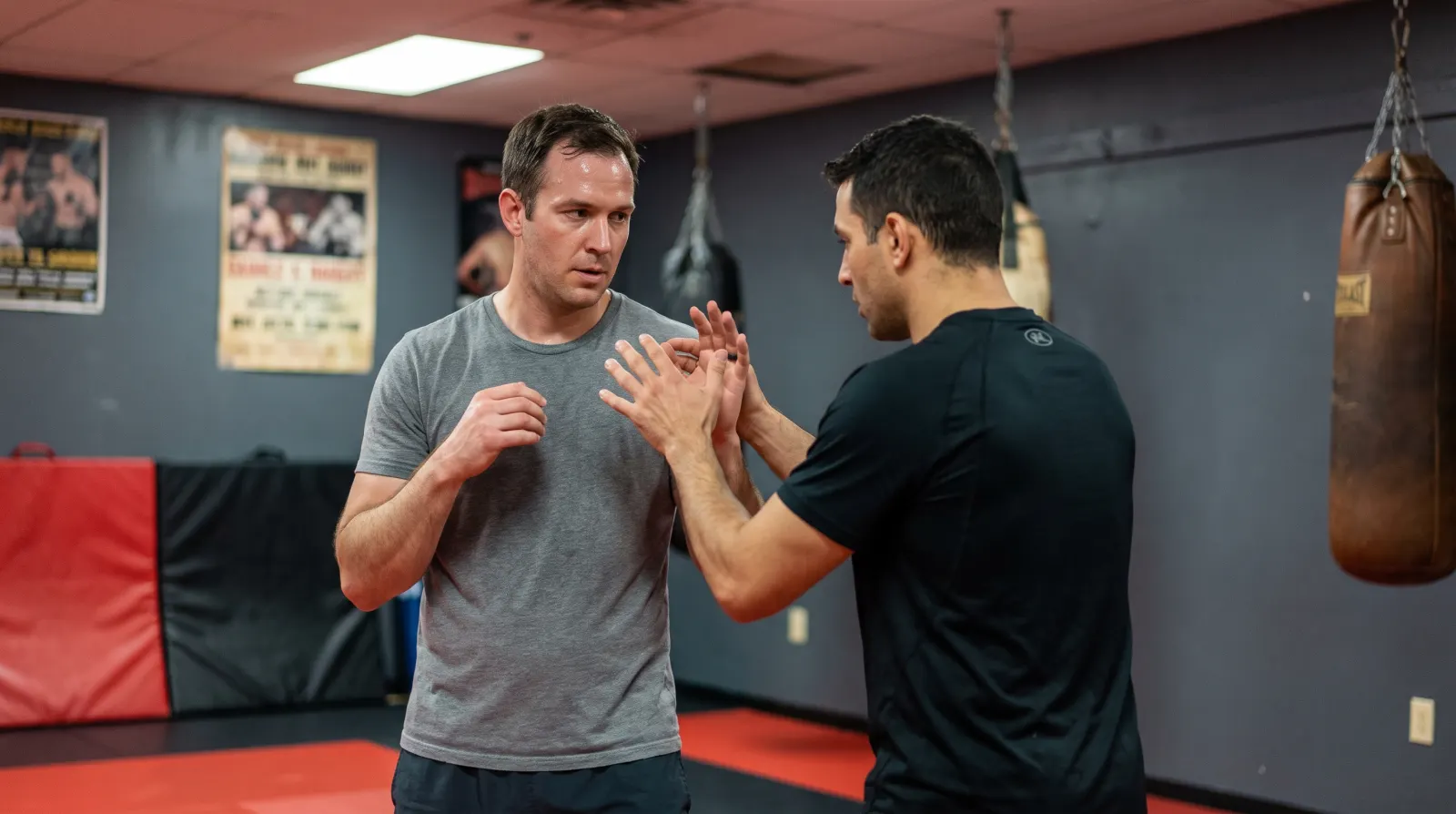
Almost every adult who walks into one of our gyms for the first time says a version of the same three things. I'm not in shape. I've never done this. I don't want to spar and get hurt. I've been coaching in Northern Virginia for over twenty years, and I've heard it from nurses, software engineers, dads in their forties, and college kids who never played a sport in their life. So if that's you, you're not the exception. You're the normal case.
Here's the honest version of what starting martial arts as a total beginner actually looks like: whether you need to get fit first, what a real first class feels like, how the first few months are paced, whether you have to spar, and the mistakes that make people quit in month one. No hype, just what we actually see.
Can you start martial arts as an adult with zero experience?
Yes, and most of the adults training with us started exactly there. Every good program is built around the assumption that a beginner knows nothing, so your first classes are slow, technical, and low-contact by design. You do not need any background in sports, any flexibility, or any idea what you're doing. The whole point of a beginner class is to take someone off the couch and teach them one small piece at a time. The people you'll see who look smooth and confident were all in your spot once, usually more recently than you'd guess.
Do I need to get in shape before I start?
No. Getting in shape is what the training is for, not something you do beforehand. This is the single most common thing that stops adults from starting, and it's backwards. You do not need to run a mile or lose weight first. Class is scalable, so on day one you go at your own pace, take water breaks whenever you need them, and stop drills before you're gassed. Nobody is watching you or judging your conditioning. Within a few weeks the same class that wrecked you starts to feel normal, because your body adapts fast when you show up consistently. Waiting until you're fit enough to start martial arts is like waiting until you can swim before getting in the pool. If getting in shape is your main goal, here's exactly what BJJ does to your body.
What a first class actually feels like
Your first class is mostly learning the room and a couple of basic movements, not a workout that breaks you. You'll usually get there early, meet the coach, and get walked through where to stand and what to do. A typical beginner session runs a light warm-up, then technique, where a coach shows one move slowly and you drill it with a partner or on a bag, then some conditioning, then a cool-down. You'll feel awkward and a step behind, and that's completely expected. Everyone does. The coaches are watching to help you, not to grade you. We walk through this in more detail in our guide to what to expect at your first MMA class, but the short version is: you'll survive it, and you'll probably want to come back.
The honest on-ramp: your first three months
Progress in martial arts is paced in stages, and knowing the stages kills most of the fear. Here's the realistic arc we use for adult beginners.
| Stage | What you're doing | Contact level |
|---|---|---|
| Weeks 1 to 2 | Learning the basics, footwork, positions, breathing. Getting your fitness moving. | None. Drills and bag work only. |
| Weeks 3 to 6 | Stringing moves together, light positional drills with a partner who's cooperating. | Light and controlled, only if you're ready. |
| Week 8 and beyond | You choose your depth. Stay technical, or add structured sparring at your pace. | Your call, always supervised. |
The thing to notice is that nothing is rushed and nothing is sprung on you. You are not thrown in with experienced people on day one. By the time any real contact happens, you've got a foundation and a coach managing the pace.
Do I have to spar or get hit?
No. You can get most of what martial arts offers, the fitness, the skill, the confidence, the stress relief, without ever sparring. This is the fear that keeps the most adults away, so I want to be direct about it. A huge amount of training happens with no opponent trying to hurt you: drilling technique, hitting bags and pads, positional work with a cooperative partner. If you want to add sparring later it's there, and when you do it starts extremely light with a coach right next to you controlling it. If you never want to spar, that's a normal and common way to train with us for years. We'll never push you past what you signed up for.
Which martial art should a total beginner pick?
The best first martial art depends on what you actually want out of it, and any of these are beginner-friendly. Here's the honest breakdown so you can match it to your goal.
| If you want... | Start with... | Why |
|---|---|---|
| The lowest injury risk and the best self-defense for most people | Brazilian jiu jitsu | No striking. You learn control on the ground, and a smaller person can handle a bigger one. |
| A hard cardio workout and to hit something | Boxing or kickboxing | Conditioning disguised as skill. You can train for months and never spar. |
| A bit of everything and the full picture | MMA | Blends striking and grappling. Best if you're not sure and want variety. |
| Practical, real-world safety skills | Self-defense | Focused on awareness and getting out of common situations, not competition. |
Honestly, most beginners can't go wrong starting with jiu jitsu or boxing. If you're stuck, our comparison of MMA vs boxing vs BJJ lays out the trade-offs, and you can always try a couple and see what clicks. For the deeper dive on grappling specifically, our BJJ for beginners guide covers what your first month on the mat looks like, and the boxing for beginners breakdown does the same for striking.
The three things adults get wrong in the first month
Most people who quit early do it for reasons that are completely avoidable. After twenty years I see the same three every time.
The first is going too hard, too soon. New adults get excited or competitive, train five days in week one, wreck themselves, and burn out by week three. Start with two or three classes a week and let your body catch up. Consistency over months beats intensity over days, every time.
The second is comparing yourself to everyone else in the room. You'll look at someone who moves well and feel behind. That person has months or years on you. The only fair comparison is you last week versus you today. Martial arts is one of the few things where you can literally feel yourself getting better, if you stop measuring against the wrong people.
The third is quitting during the awkward stage before it clicks. Weeks two through four are the hardest, because you know just enough to feel clumsy but not enough to feel capable. Almost everyone who pushes through that month stays for years. The people who leave almost always leave right before it would have started to feel good.
Am I too old to start martial arts?
Almost certainly not. We have adults starting in their thirties, forties, and fifties, and plenty of them train for years. Age changes how you train, not whether you can. An older beginner picks class times with a lighter intensity, warms up properly, is honest with the coach about old injuries, and skips the hard live sparring unless they truly want it. What you lose in raw recovery you make up for in patience and consistency, which is exactly what martial arts rewards. Being an adult is genuinely a good time to start, because you show up on purpose and you listen. If self-defense is part of why you're starting, our piece on the best martial arts for self-defense is worth a read, and women looking for a comfortable entry point should see our guide to martial arts and self-defense for women. If you're over 50, we go deeper on how to start safely at that age in our guide to martial arts for seniors.
How to actually start
The simplest path is to book a free trial and just come see a class. You don't need gear, a membership, or any prep. Wear a t-shirt and shorts, bring water, and show up ten minutes early so the coach can walk you in. We run adult classes across our Northern Virginia locations at a range of times, so you can find a slot that fits work and life. Take a look at the class schedule to see what works, then grab a free trial and try it. If striking is what pulled you in, Muay Thai for beginners breaks the first month down week by week. The hardest part is walking in the first time. After that, it's just showing up.
Is it embarrassing to start martial arts as an adult beginner?
No, and it's a lot less awkward than people expect. Everyone in the room was a beginner once, and adult classes are full of people at every level. Coaches are used to teaching from zero, and nobody is watching or judging your first attempts. The self-consciousness fades within a couple of classes.
How long until I'm any good at martial arts?
You'll feel noticeably more capable within a few months of consistent training. Real competence takes longer, often a year or more, and belt or skill milestones vary by art. But "any good" for most adults means feeling fitter, more confident, and able to handle the basics, and that comes surprisingly fast if you train two or three times a week.
What should I wear to my first class?
A plain t-shirt and athletic shorts or leggings work for almost any first class. For grappling like jiu jitsu we'll usually loan you a gi for your first session, so don't buy gear yet. Bring water and, if you already have them, hand wraps for boxing. The gym has the rest.
Will I get hurt training martial arts as a beginner?
Serious injury is uncommon for beginners because your early training is low-contact by design. The usual first-month soreness is normal muscle fatigue, not injury, and it fades as you adapt. Good coaching, controlled drilling, and starting slow keep the real risk low. Tell your coach about any old injuries so they can adjust.
How many days a week should an adult beginner train?
Two to three classes a week is the sweet spot when you're starting out. It's enough to build skill and see progress, while leaving your body time to recover and adapt. You can add more once training feels normal, but starting with fewer days and staying consistent beats going hard and burning out.