
People search for cardio kickboxing when what they actually want is to be fitter and to enjoy the hour it takes. That is a good instinct. But cardio kickboxing and a kickboxing class at a martial arts gym are two different things wearing a similar name, and picking the wrong one is the reason I see people drift off in month two.
I coach at our Ashburn academy. I get this question in the lobby constantly, usually phrased as some version of "is this the punch-a-bag-to-music thing?" Here is the honest answer, including who each option is genuinely better for.
Short answer: what is cardio kickboxing, and how is it different?
Cardio kickboxing is a group fitness class that borrows striking movements and runs them as a workout. You follow an instructor at the front, usually to music, often in the air or on a bag, and nobody corrects your mechanics because that is not the point. The point is your heart rate.
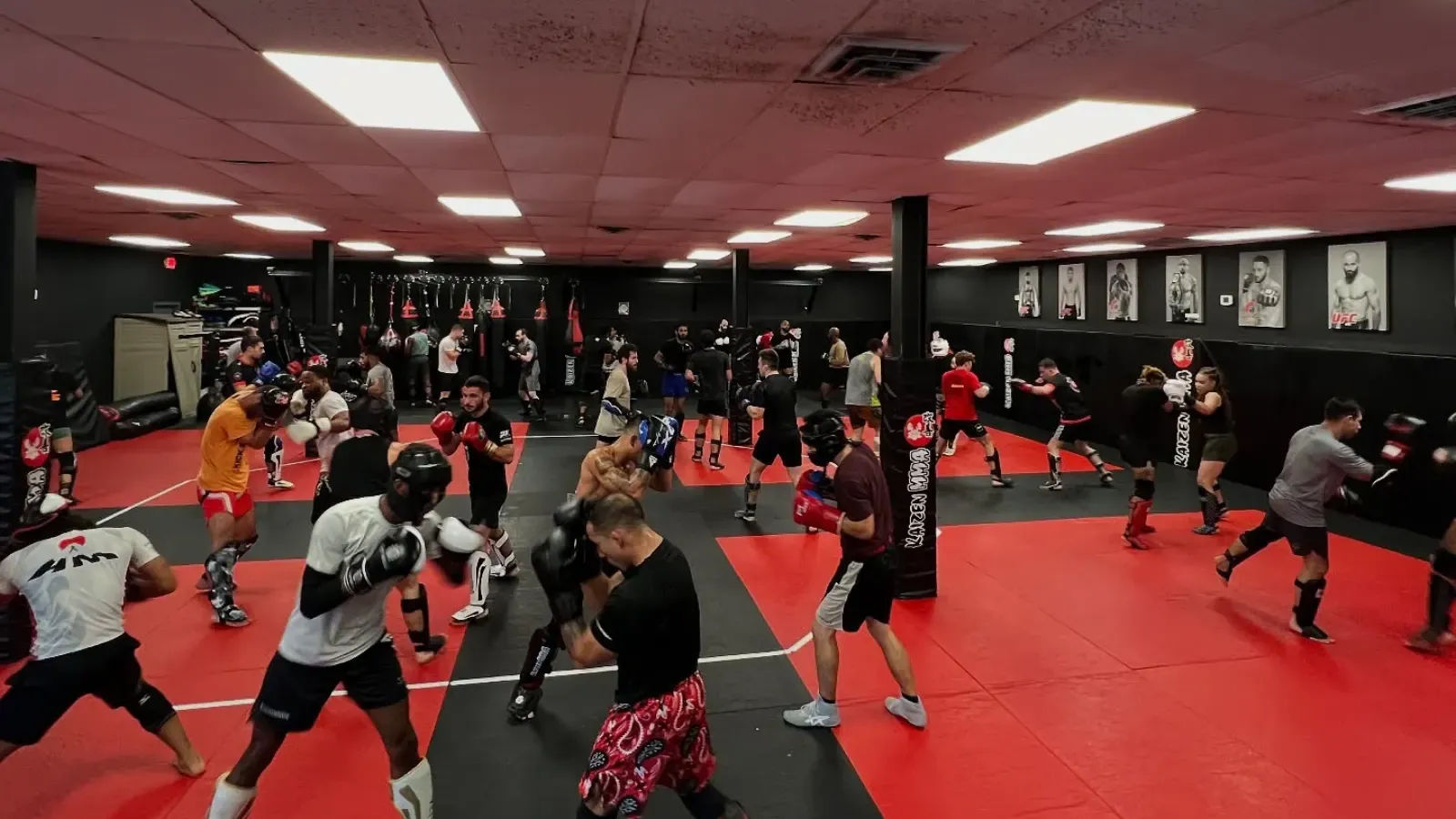
A kickboxing class at a martial arts gym is a skill class that happens to be an excellent workout. A coach breaks down two or three techniques, you drill them, and you spend most of the hour hitting pads that a partner holds. You get corrected. You get better at something specific.
Both leave you soaked. Only one leaves you able to do something you could not do before.
Cardio kickboxing vs a kickboxing class, side by side
| Cardio kickboxing | Kickboxing class at a gym like ours | |
|---|---|---|
| Main goal | Calorie burn and heart rate | Technique, with the workout as a byproduct |
| Who leads it | A group fitness instructor | A coach who trains and competes in the sport |
| What you hit | Air, or a bag on your own | Pads held by a partner, plus bags |
| Do you get corrected | Rarely, the class does not stop | Yes, that is the whole job |
| Partner work | None | Yes, from week one, on pads rather than each other |
| Progression | Harder rounds over time | New techniques, then timing, then live drilling |
| Self-defense value | Close to none | Meaningful, because the mechanics get corrected |
| Best for | Someone who wants a fun sweat and nothing else | Someone who wants to get fit and also get good |
Neither column is wrong. If you want forty-five minutes of loud, sweaty movement with zero learning curve, cardio kickboxing does that well and there is no shame in it. This piece exists because a lot of people pick that column by accident, get bored, and conclude that kickboxing was not for them.
Is kickboxing a good workout, and what actually makes it hard
Yes, and the reason is structure, not intensity for its own sake. A pad round is interval training you forget you are doing. You work for two or three minutes at a high output, rest while your partner works, and repeat. Your heart rate climbs and falls in exactly the pattern that builds conditioning.
What surprises most beginners is where the fatigue comes from. It is not the punches. It is holding your hands up for a full round, staying on the balls of your feet, and resetting your stance after every combination. Those are postural and stabilizing muscles that most desk jobs never touch. Your shoulders and calves will tell you about it the next day.
The kicking adds a second layer. A proper roundhouse rotates from the hip and the standing foot, so you end up training rotational power and single-leg balance, two things almost nothing else in a normal gym trains together.
Kickboxing for weight loss: what it does and what it does not
It helps, and the mechanism is not mysterious. An hour of pad and bag work is a large amount of full-body output, and the interval structure keeps you working longer than you would on a treadmill because you are paying attention to something else.
Here is the part most articles skip. Diet still decides most of your result. Training three times a week and eating the same way you always have will make you fitter, stronger, and better coordinated, and it may not move the scale much. That is not a failure of the class. It is arithmetic.
The weight-loss advantage of a skill class is adherence. People quit workouts they find boring. Almost nobody quits something they are visibly getting better at. On our mats, the members still training a year later are overwhelmingly the ones who got interested in the technique. Consistency is the variable that matters, and skill is what buys it.
Which one you should pick, based on what you actually want
Ask yourself one question: in a year, do you want to be fitter, or do you want to be fitter and also know how to strike? There is no wrong answer, but they lead to different rooms.
- You want a workout and nothing more. Cardio kickboxing at a fitness studio is a fine fit. Go, enjoy it, do not overthink it.
- You want a workout but you get bored fast. Come to a technique class. The learning is what keeps people coming back, and the conditioning happens anyway.
- You want to be able to defend yourself. Only a technique class does this. Striking mechanics you were never corrected on do not hold up under pressure. Our take on that is in whether Muay Thai works for self-defense.
- You are nervous about walking into a martial arts gym. Reasonable, and extremely common. Read what starting with no experience is actually like first.
What a beginner kickboxing class at Kaizen looks like
Roughly the same four blocks every time. A warm-up of jump rope or light movement, then shadow boxing while the coach walks around fixing stances. Then technique, where you get shown two or three things and drill them slowly before you drill them fast. Then pad rounds with a partner. Then a conditioning finisher and a stretch.
You will be paired with someone. That is the part people worry about, and it is the part everyone ends up liking, because the person holding your pads is invested in you throwing it correctly. In a beginner class you are working pads and bags, not each other. Holding pads for a beginner is a normal, expected job, and everyone does it.
Sparring is a separate thing entirely. It is always optional here, always controlled, and only opens up once you have built a solid foundation. Many of our members never spar at all and still get everything they came for. If you want the fuller walkthrough of a first striking class, we wrote one for Muay Thai beginners, and the format is nearly identical.
Kickboxing, Muay Thai, and boxing: which door to walk through
These names confuse people, so quickly. Boxing is hands only, and it is the fastest way to feel competent because you have fewer variables. Kickboxing adds kicks. Muay Thai is the most complete version of kickboxing, adding elbows, knees, and clinch work.
At Kaizen the striking curriculum runs across all three rather than siloing them, so the class name on the schedule tells you where the emphasis sits that hour, not which sport you are locked into. If you want hands first, start in a beginner boxing class. If you want the whole stand-up game, start in Muay Thai, and the full Muay Thai vs kickboxing comparison covers exactly what the extra weapons buy you. If you want a look at how striking compares to grappling before you commit, we broke that down in MMA vs boxing vs BJJ.
Where our kickboxing and striking classes run in Northern Virginia
Six academies, and the entry point differs slightly at each. These are the beginner-friendly striking slots as of now, and the full schedule is always the current version.
| Academy | Beginner striking classes |
|---|---|
| Falls Church | Beginner Kickboxing, Tuesday and Thursday 6:00 to 7:00 PM. Muay Thai Monday and Wednesday 6:00 to 7:00 PM, Saturday 3:15 to 4:15 PM. |
| Fairfax | Muay Thai and Kickboxing Fundamentals, Monday and Wednesday 8:15 to 9:15 PM, Saturday 10:00 to 11:00 AM. |
| Vienna | Muay Thai, Monday and Wednesday 7:00 to 8:00 PM, Friday 6:30 to 7:30 PM. |
| Ashburn | Kickboxing, Tuesday 8:00 to 9:00 PM. Muay Thai Monday 6:00 PM, Tuesday and Thursday 9:00 AM, Saturday 9:00 AM. |
| Purcellville | Kickboxing, Monday 8:00 to 9:00 PM. |
| South Riding | Muay Thai and Kickboxing, Tuesday and Thursday 7:00 to 8:00 PM, Saturday 12:00 to 1:00 PM. |
A few notes worth knowing. Falls Church also runs a Kickboxing Team block on Saturday, but that one is invite only and not where anyone starts. Ashburn has morning Muay Thai, which is the useful option if evenings are impossible for you. If you are weighing one location over another, our guide to choosing a martial arts gym in Northern Virginia covers what to look at beyond the drive.
What to wear and bring to your first class
Athletic clothes you can move in, shorts or joggers with a t-shirt or rash guard. We train barefoot, so leave the shoes at the door. Bring water and a towel.
Do not buy gear yet. We have loaner gloves for your first few classes, and hand wraps are worth owning eventually but not before you know you are staying. Buying a full kit the week before you start is how people end up with a bag of equipment and a story about the time they tried kickboxing.
Common questions about cardio kickboxing and kickboxing classes
Is cardio kickboxing the same as kickboxing?
No. Cardio kickboxing is a group fitness class built around striking movements, usually to music, with no partner and no coaching on mechanics. A kickboxing class at a martial arts gym teaches you the strikes themselves, on pads, with someone correcting your form. Both make you sweat. Only one builds skill.
Is kickboxing a good workout for weight loss?
It works for the same reason any hard interval training works. Pad rounds push your heart rate up, rest brings it down, and you repeat that for an hour. What makes it stick is that you are learning something, so you keep showing up. Diet still decides most of the result.
Do I need to be fit before my first kickboxing class?
No. Month one is stance, footwork, and basic combinations at a pace you set. Coaches scale every drill. Most people who walk in have never thrown a punch, and the first few weeks are more about coordination than conditioning. Sit out a round whenever you need to.
Will anyone hit me in a beginner kickboxing class?
A beginner class is pad and bag work, not partner contact. Sparring at Kaizen is a separate, optional thing that only opens up once you have built a solid foundation, and it is always controlled. Plenty of our members train for years and never spar at all.
How many times a week should I train kickboxing?
Two a week is enough to get fitter and start retaining technique. Three moves you noticeably faster. One a week keeps you familiar but progress is slow, because striking is a motor skill and motor skills need repetition. Pick a slot you can actually make every week.
How to try it before you decide
You do not have to resolve any of this in your head. Come to one class and the question answers itself, because an hour on the pads tells you more about whether you like this than a week of reading will.
Book a free trial class at whichever academy is closest, or look through the kickboxing program and the wider striking curriculum first if you want more detail before you commit to a time. Wear shorts, bring water, and show up ten minutes early so someone can walk you around before class starts.