
Muay Thai has a reputation problem with beginners. People picture shin conditioning on tree trunks and somebody getting cracked in the head on day one, decide they aren't ready yet, and never walk in. Then they finally show up and spend the first ten minutes annoyed at themselves for waiting.
I teach at our Vienna academy. The honest version is far less dramatic than the internet version. A beginner class is a warm-up, some shadow boxing, a coach breaking down two or three techniques, and then you hitting pads that a partner holds for you. That's most of it. Here's what your first class and your first month actually look like.
Short answer: can a complete beginner start Muay Thai?
Yes, and nearly everyone in a beginners class started exactly there. You don't need to be fit, flexible, or coordinated first, because month one is technique and pad work at a pace you set. You won't spar in your first class or your first month. That comes later, once you've built a base. Wear shorts and a t-shirt, bring water, and expect to leave tired and a little sore rather than hurt.
The thing that stops most people isn't the training. It's the first walk through the door. Nothing after it is as hard as the version in your head.
What actually happens in a beginner Muay Thai class
Almost every beginner class I've taught runs the same four blocks, and knowing them in advance takes most of the nerves out of the first hour.
Warm-up, roughly ten minutes. Skipping rope or light movement, then shadow boxing, which is you throwing punches at nobody in particular while the coach walks around fixing your stance. It looks strange the first time. Everyone in the room felt the same way once.
Technique, roughly fifteen minutes. The coach demonstrates two or three things, slowly, then breaks them down step by step. Week one that's usually the stance, the jab, and the teep, which is the straight push kick. Nothing more. Muay Thai has eight weapons and we hand them over a couple at a time on purpose.
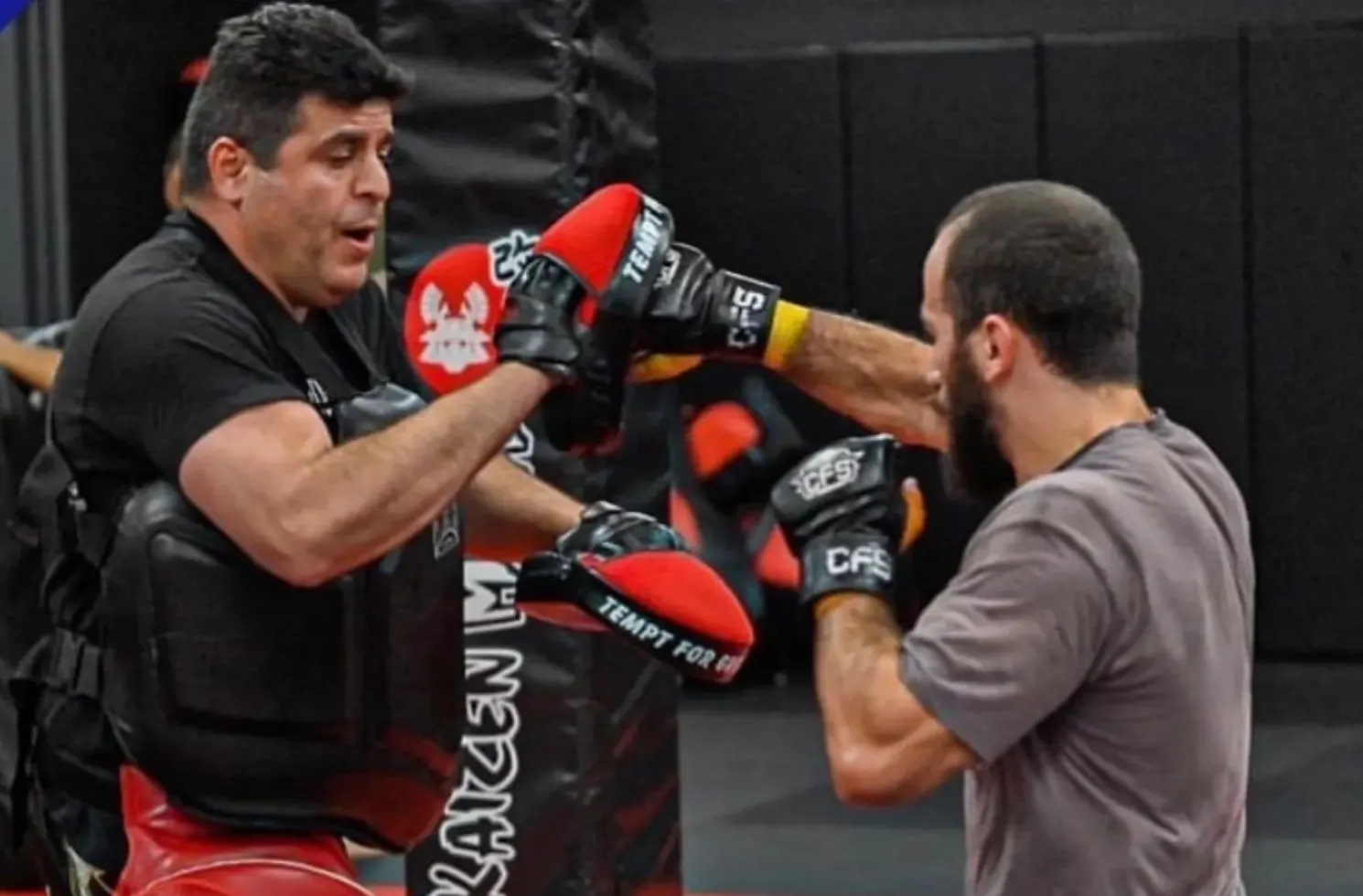
Pad work, roughly twenty-five minutes. You partner up, one person holds a pad and the other one hits it, then you switch. Your partner is not trying to catch you out. They're standing there holding a target and telling you when you land it clean. It's the loudest part of the hour, and the part most people come back for.
Conditioning and stretching to finish. Some core work, some stretching, done. You'll be breathing hard. Nothing about it is designed to hurt you.
The Art of Eight Limbs, explained without the mystique
Muay Thai gets called the Art of Eight Limbs because it uses two fists, two elbows, two knees, and two shins. Boxing has two weapons. Muay Thai has eight, which sounds like eight times the learning curve, and it isn't, because you don't learn them all at once.
A beginner gets the jab and the cross first, because the hands set up everything else. Then the teep, because it's the easiest way to keep space. Then the round kick, which is the shot Muay Thai is known for and the one that takes the longest to make look right. Knees and elbows come later, and in a fundamentals class they're mostly taught on pads rather than on a person. Nobody is throwing elbows at you in month one.
What to wear and bring to your first Muay Thai class
Shorts, a t-shirt, and water. That's it for a first class. We train barefoot, so leave the shoes at the edge of the mat. We'll loan you gloves so you're not buying gear for a class you haven't decided you like yet.
If you train past the first couple of weeks and want your own kit, the order that makes sense is hand wraps first, then gloves, then shin guards once you start hitting pads with your legs regularly. Hand wraps are the cheap item that prevents the most annoyance. Loose wrists and sore knuckles are what I see send new people home early, and a wrap fixes both. Ask a coach to show you how to wrap rather than following a video. It takes a couple of minutes to learn in person.
One thing to skip: don't buy shin guards or a mouthguard before you've trained a month. You'll guess the size wrong.
Will I get hit in my first Muay Thai class?
No. Not in your first class, and not in your first month.
This is the question I get most often and I'd rather answer it flatly. Beginner classes at our academies are technique and pad work. Sparring is a separate, later, opt-in thing that happens after you've built a base, and even then it starts light and controlled with someone who knows how to hold back. Plenty of adults train with us for a year or more, get in great shape, learn to strike properly, and never spar once. That's a completely normal way to do this.
What you will feel is contact with pads and bags, which is a different animal. Your shins will be tender the first couple of weeks. Your knuckles will be a bit sore. That fades as your body adapts, and it's the same adaptation runners go through in their first month.
Muay Thai vs kickboxing: the difference that matters to a beginner
People use these two words interchangeably and then get confused when a schedule lists both. The short version: kickboxing is punches and kicks, Muay Thai is punches, kicks, knees, elbows, and clinch work. Muay Thai is the bigger toolbox. We went deeper on this in Muay Thai vs kickboxing, including the rulesets and the stance difference.
Worth separating out a third thing people lump in here: cardio kickboxing is not the same as a kickboxing class, and the difference decides whether you walk out with a skill or just a sweat.
| Muay Thai | Kickboxing | |
|---|---|---|
| Weapons used | Fists, elbows, knees, shins | Fists and legs |
| Clinch | Yes, a core part of it | Broken up or not allowed |
| Kicking style | Shin as the contact point, rotational | Often the instep, snappier |
| Pace | Steadier, heavier shots | Faster, higher volume |
| Better first pick if you want | The full striking skill set and clinch control | A simpler, faster on-ramp and pure conditioning |
For a beginner walking in off the street, the practical difference in the first three months is small. You're learning stance, hands, and kicks either way. Several of our locations run the two together for exactly that reason. Pick the class time that fits your week and sort out the distinction later, once you've got a feel for it.
Your first month in Muay Thai, week by week
Week one. You'll feel uncoordinated and that's the correct feeling. Almost everyone kicks with their toes instead of their shin on day one, drops their hand after the jab, and leans back away from the pad. All three are normal and all three get fixed by a coach standing next to you. Expect to be sore in your obliques and your hips, which are muscles the gym rarely touches.
Week two. The soreness moves to your shins. This is the week people quietly decide whether they're doing this or not. It passes. Train through it at a lighter contact level and it's gone within days.
Weeks three and four. Something clicks in the pad round. You stop thinking about each individual movement and start throwing a two-shot combination without narrating it in your head. That's the moment most people get hooked. It's also when your conditioning changes noticeably. Round five stops feeling like a survival exercise.
Past month one. You start adding knees, learning to check a kick, and getting introduced to the clinch. If sparring interests you, that conversation happens somewhere around month three to six depending on you, and never before you're ready.
How often should a beginner train?
Two classes a week is the floor for making real progress, and three is the sweet spot for most working adults. One class a week means you spend most of each session re-remembering last week, which is frustrating and slow.
Two sessions with a rest day between them is more useful than two sessions back to back when you're new, because the soreness in weeks one and two is real. If you're coming in with no training history at all, start at two and add a third once your body stops complaining. There's no prize for doing five a week in month one and then disappearing in month two.
Where we run beginner Muay Thai classes in Northern Virginia
Kaizen teaches striking across our Northern Virginia academies, and the beginner-friendly slots differ by location. These are the current adult striking times, though schedules do shift, so check the class schedule for the week you're planning to come in.
| Location | Beginner-friendly striking classes |
|---|---|
| Fairfax | Muay Thai and Kickboxing Fundamentals, Monday and Wednesday 8:15pm, Saturday 10am. Explicitly a beginners class. |
| Falls Church | Beginner Kickboxing, Tuesday and Thursday 6pm. Muay Thai beginner and advanced together, Monday and Wednesday 6pm, plus an all-levels class Saturday 3:15pm. |
| Vienna | Muay Thai Monday and Wednesday 7pm, Friday 6:30pm. |
| Ashburn | Muay Thai Monday 6pm, Tuesday and Thursday 9am, Saturday 9am, plus a Tuesday 8pm kickboxing class. |
| Purcellville | Kickboxing Monday 8pm. |
Two things worth knowing when you pick. The Fairfax fundamentals class is labelled a beginners class on the schedule, so if the idea of walking into a mixed-level room bothers you, start there. And the Ashburn 9am morning slots are the quiet option for anyone whose evenings are already spoken for, which is most parents.
Is Muay Thai the right first martial art for you?
Muay Thai suits you if you want to learn to strike properly, you want conditioning that doesn't feel like exercise, and standing up appeals to you more than being on the ground. It's the most direct route to competent striking that I know of, and the conditioning arrives whether you asked for it or not.
It suits you less if your main goal is self-defense against being grabbed or taken down, in which case grappling deserves a look first. We laid out the trade-offs in Muay Thai vs BJJ, and if self-defense is the whole reason you're searching, is Muay Thai good for self-defense answers that directly. If you're weighing striking arts against each other, boxing vs Muay Thai is the direct head-to-head, and MMA vs boxing vs BJJ plus boxing for beginners cover the neighbours. Plenty of people end up doing two of these at once, and that's fine.
If the not-in-shape-yet thing is what's holding you up, read martial arts for adults with no experience first. Same answer as this piece, applied more broadly.
Common questions before your first Muay Thai class
Do I need to be in shape to start Muay Thai?
No. You build the fitness by training, not before it. A beginner class scales to whoever is in the room, and you can pause, drink water, or sit out a round any time. Most people arrive with no athletic background at all and notice their conditioning change within about a month.
How long does it take to get decent at Muay Thai?
Most people feel competent throwing basic combinations on pads within two or three months of consistent training. Fluency, where the technique happens without you thinking about it, takes a year or two. The early progress is steep and satisfying, which is what keeps beginners coming back.
Is Muay Thai good for weight loss?
It's excellent for it, mostly because people stick with it. An hour of pad work and conditioning is hard cardio, but that isn't really why it works. It works because you're learning something, so you keep coming back. Almost nobody quits a gym because the workout was too easy.
What's the minimum age for adult Muay Thai classes?
It varies by location, so this is one to ask about directly. Some of our academies bring teens into the adult striking classes once they're ready, and some keep them in the kids and teens program. Call the academy closest to you and they'll tell you which class fits.
Can I just watch a class before I sign up?
Absolutely, and we'd encourage it. Come sit on the side and watch a full hour. You'll see the pace, the coaching, and how beginners are treated, which tells you more than any description. Your first class is free whenever you're ready to try it.
Come try one class
You'll know within a single hour whether this is your thing. That's why the first class is free. One round on the pads answers more than a page like this can. Come try a free class, look at the schedule for the location nearest you, and read up on the Muay Thai program or our broader striking classes if you want the detail first. Wear shorts, bring water, and let the coach know it's your first time. We'll take it from there.