
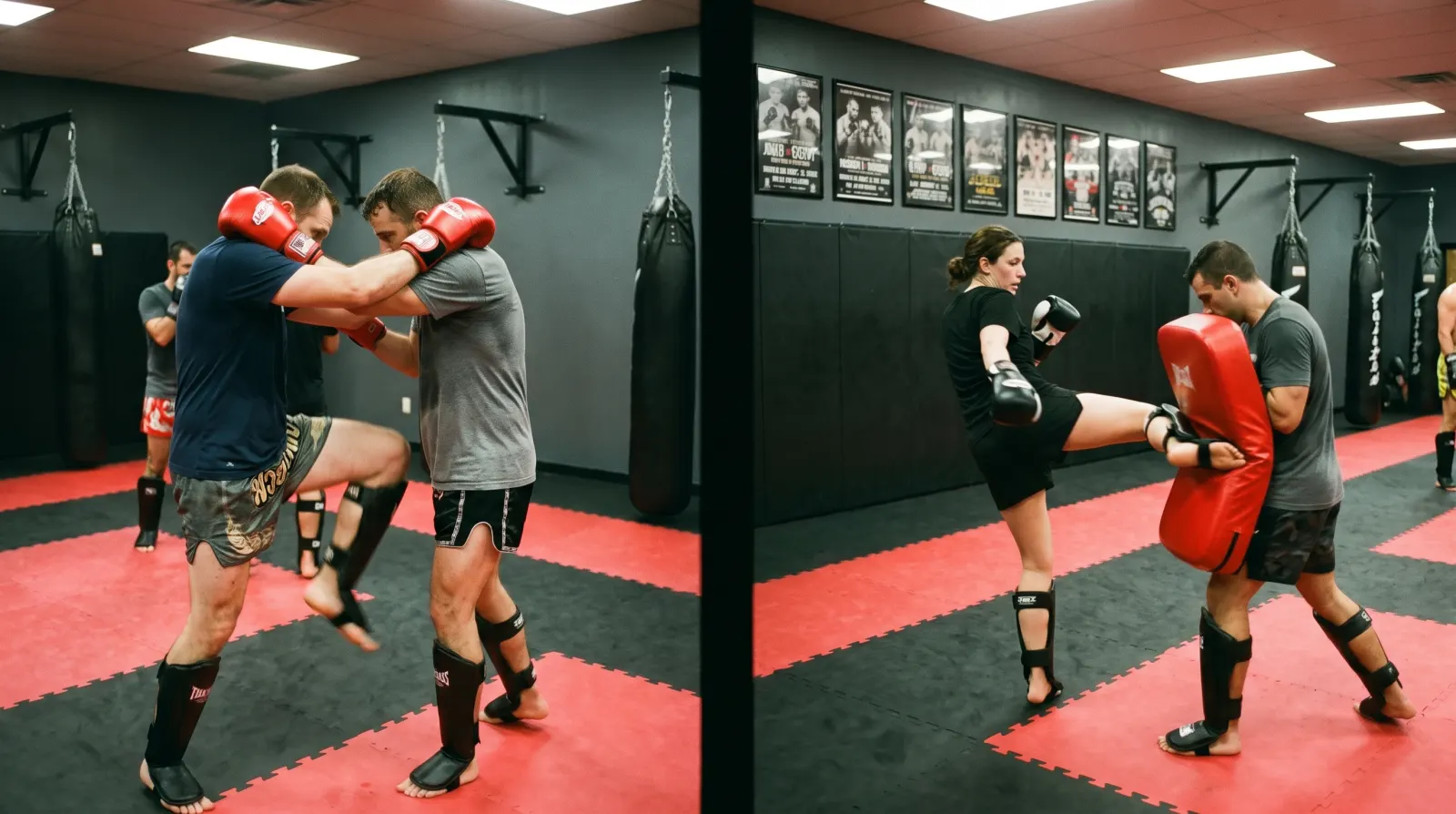
Muay Thai and kickboxing look like the same sport from the doorway. Gloves, shin guards, pads, kicks. The difference is what you're allowed to do once you get close. Muay Thai adds elbows, knees and the clinch. Kickboxing keeps it to punches and kicks, and keeps you moving.
I coach at our Vienna academy. This is the question I get most at the front desk, usually from someone with a schedule in their hand trying to decide which hour to walk into. Here's the honest version, including which one I'd put you in based on what you actually want.
Short answer: what is the difference between Muay Thai and kickboxing?
Muay Thai uses eight points of contact: two fists, two elbows, two knees, two shins. That's why it's called the art of eight limbs. Kickboxing uses four: two fists and two legs. Muay Thai also allows the clinch, sweeps and heavy low kicks. Most kickboxing rulesets ban elbows, cut the clinch short or ban it outright, and some ban leg kicks entirely.
That's the whole thing. Everything else, the stance, the pace, the way each one gets taught, follows from that one rule difference.
Muay Thai vs kickboxing, side by side
| Muay Thai | Kickboxing | |
|---|---|---|
| Weapons | Fists, shins, elbows, knees | Fists and legs |
| Elbows | Yes | No, in every common ruleset |
| Knees | Yes, including from the clinch | Allowed in some rulesets, rare in others |
| Clinch | Central to the sport | Broken up quickly or not allowed |
| Low kicks | Yes, a primary weapon | Yes in Dutch and K-1 style, banned in American full contact |
| Sweeps and throws | Sweeps allowed | Not allowed |
| Stance | Squarer, weight centered so you can check kicks | More bladed and mobile, more head movement |
| Pace | Patient, heavier shots, more clinch work | Higher output, more punches per exchange |
| Learning curve | Longer, there's simply more to learn | Shorter to feel competent |
| Carries into MMA | Directly, the clinch and knees transfer | Partly, the hands and footwork transfer |
The eight limbs: elbows and knees are the whole difference
Elbows and knees are the two tools kickboxing gives up. Both are short-range weapons, which is the point. When someone closes the distance on you, punches and kicks lose their room to work. Elbows and knees don't need room.
In class this shows up less dramatically than people expect. You drill elbows on pads and on the bag, you learn the angles, and you almost never take one in training. Nobody spars elbows in a fundamentals class. Not here. The knee is the same story, learned on pads and in controlled clinch work first.
If you've read our Muay Thai beginner guide, the eight-limb toolkit is the reason your first month feels like it has more homework than a kickboxing month would.
The clinch is the real dividing line
The clinch is where the two sports actually separate. In Muay Thai you can grip the head and neck, control posture, walk your partner off balance, land knees and finish with a sweep. It's a whole second skill living inside the sport.
In kickboxing, a referee breaks that up almost as soon as it starts. The sport is built to keep both people striking at range.
For a new adult this matters more than it sounds. The clinch is where people gas out first. Ten minutes of light clinch rounds will wind you more than you expect, and it's the part beginners underestimate. It's also what makes Muay Thai people comfortable when somebody is holding onto them, which is worth more than the sport version of it suggests.
Kickboxing is not one thing: the rulesets you will actually meet
Here's the part that confuses people. Kickboxing isn't a single sport with a single rulebook. Three versions turn up in American gyms.
- American or full contact kickboxing. Strikes above the waist only. No leg kicks at all. Closest to boxing with kicks added.
- Dutch style and K-1 rules. Punches, kicks, low kicks, and usually knees. The clinch is allowed for a moment, long enough for one strike, then broken. This is the version most gyms mean.
- Cardio kickboxing. Not a ruleset at all. It's a group fitness class that borrows the movements, and it's a different product entirely.
When a Northern Virginia gym puts "kickboxing" on a schedule, it almost always means the Dutch-influenced version: hands, kicks, low kicks, no elbows, no long clinch. If you want the fitness-class version instead, we wrote a whole piece on cardio kickboxing versus a kickboxing class.
Leg kicks change the way you stand
Give someone permission to kick your lead leg and your whole posture changes. Muay Thai stances sit squarer, with weight closer to centered, because you need to lift a shin and check a kick without falling over. The teep, the push kick, becomes the tool that manages distance.
Kickboxing stances tend to sit more bladed, lighter on the front foot, with more head movement and more punches strung together. In the rulesets with no low kicks, standing side-on costs you nothing, so people stand side-on.
The practical version of this: when a boxer joins our Muay Thai class, their lead leg takes a beating for the first few weeks. It isn't a conditioning problem. It's a stance problem, and it fixes itself once checking becomes a habit. Boxers coming the other way, into a beginner boxing class, never have this issue. That crossover, and which of the two to start with, is the whole subject of boxing vs Muay Thai.
Which one is better for self-defense?
Both are genuinely useful, and the honest answer is that the gap between them is smaller than the gap between either one and doing nothing. If I had to split hairs: Muay Thai's elbows, knees and clinch cover the close range where confrontations tend to end up, and that's an edge.
The bigger caveat applies to both. Neither one teaches you what to do on the ground, which is why we cross-train grappling and why our breakdown of the best martial arts for self-defense doesn't crown a single winner. There's more depth on the striking side of that question in is Muay Thai good for self-defense.
How to pick, based on what you actually want
- You want the most complete striking skill set. Muay Thai. There's more to learn, and more of it stays useful.
- You want to feel competent sooner. Kickboxing. Fewer weapons to learn means faster progress in the first three months.
- You mainly want the workout. Either will do it. If you don't care about skill at all, cardio kickboxing is the cheaper, easier door.
- You're aiming at MMA. Muay Thai. The clinch, the knees and the habit of catching kicks all carry over. See how MMA, boxing and BJJ compare.
- You've got cranky knees or hips. Start in kickboxing, keep low kicks light, and add clinch work later once you know how your body responds.
- You've never trained anything. Either. Both fundamentals classes assume zero experience, and starting as an adult with no background is the normal case here, not the exception.
Where we run Muay Thai and kickboxing across Northern Virginia
We teach both, and how they're split depends on the academy. Fairfax runs a combined fundamentals hour plus a separate advanced Muay Thai class. Ashburn keeps its own Kickboxing hour on Tuesday nights. Some academies run one or the other rather than both. Here's the current adult striking schedule.
| Academy | Muay Thai | Kickboxing |
|---|---|---|
| Falls Church | Mon and Wed 6:00pm, Sat 3:15pm | Beginner Kickboxing Tue and Thu 6:00pm |
| Fairfax | Advanced Muay Thai Tue and Thu 7:00pm | Muay Thai/Kickboxing Fundamentals Mon and Wed 8:15pm, Sat 10:00am |
| Vienna | Mon and Wed 7:00pm, Fri 6:30pm | No separate class |
| Ashburn | Mon 6:00pm, Tue and Thu 9:00am, Sat 9:00am | Tue 8:00pm |
| Purcellville | No separate class | Mon 8:00pm |
| South Riding | Muay Thai/Kickboxing combined, Tue and Thu 7:00pm, Sat 12:00pm | |
Times move occasionally, so check the full class schedule before you drive out. Program detail lives on the Muay Thai program page and the wider striking program page.
Can you train both at the same time?
Yes, and plenty of our members do. The two sports share most of their toolkit, so the second one is mostly learning what's now legal rather than learning to move again. Somebody who has trained Muay Thai for a year usually settles into a kickboxing round fast.
The one thing to watch is stance. If you're competing in both, the squarer Muay Thai posture and the bladed kickboxing posture will fight each other a little, and you'll want a coach steering that. If you're training for fitness and skill, which is almost everybody, it's a non-issue. Come to both.
Common questions about Muay Thai and kickboxing
Is Muay Thai harder than kickboxing?
It has more to learn, so it takes longer to feel competent. Elbows, knees and the clinch are three skills kickboxing doesn't ask for. Neither is harder physically. Both hours will leave you soaked, and both scale down for a first-timer.
Which is better for beginners, Muay Thai or kickboxing?
Kickboxing gets you to "I can do this" sooner because there's less material. Muay Thai gives you more once you stay. Most people should pick by schedule, not by sport.
Is Muay Thai more effective than kickboxing?
In a ruleset that allows elbows, knees and clinch work, yes, because those tools exist. Under kickboxing rules, that advantage disappears. Skill and training time matter far more than the style label, which is true across every martial art.
Do I need shin guards for both?
Eventually, yes. Both use them once you start partner drills. Show up to your first class in shorts and a t-shirt. We have loaner gear, and buying your own before you know you like it is how closets fill up.
Is kickboxing good for weight loss?
It's very good for it, and so is Muay Thai. An hour of pad work and drilling burns hard without feeling like cardio, which is the real reason people stick with it. The results come from showing up weekly, not from which of the two you picked.
Does either one help with stress?
Both, more than most people expect. An hour where your only job is to hit a pad correctly leaves very little room for whatever happened at work. It's the reason a lot of our adult members started, and the reason most of them stayed.
Come take a class before you decide
Reading about the difference only gets you so far. Ten minutes on the pads will tell you more than this whole article, and you'll know within one hour which of the two you want. Grab a free trial class at whichever academy is closest and try the one that fits your evening. If you pick wrong, you switch. Nobody's holding you to it.