
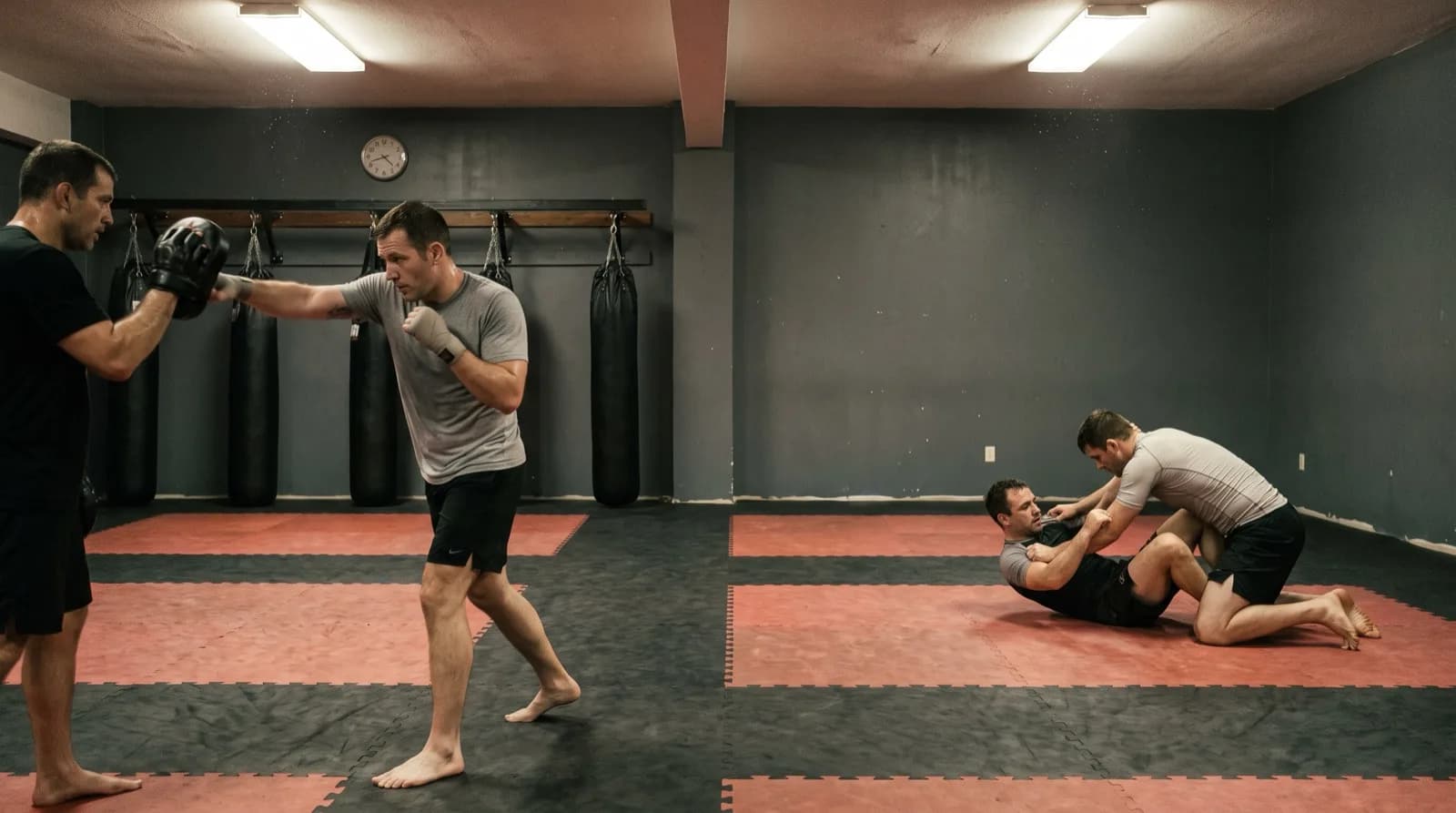
Striking is everything you do from a distance. Punches, kicks, elbows, knees. Grappling is everything you do once there's no distance left. Takedowns, control, holds, submissions. Almost every martial art is mostly one or mostly the other, and picking a class means picking a side without meaning to.
I coach wrestling at our Ashburn academy, so you already know which way I lean. That's exactly why this is worth writing honestly. Grappling is not the answer to everything, and the places where striking beats it are the places most grapplers quietly skip over.
Short answer: what is the difference between striking and grappling?
Striking is hitting from range. Boxing, Muay Thai and kickboxing are striking arts. Grappling is controlling a body at close range. Wrestling, Brazilian jiu-jitsu and judo are grappling arts. Striking decides what happens before contact. Grappling decides what happens after it.
If you only have time for one, most adults get more usable self-defense out of grappling in the first year, and more fitness and coordination out of striking. If you can train both, the order matters less than showing up twice a week.
What counts as grappling in martial arts
Grappling covers any art built around holding, moving or controlling another person's body. There's no hitting in it. The main ones you'll see in Northern Virginia:
- Brazilian jiu-jitsu. Ground control and submissions. Positions first, chokes and joint locks second.
- Wrestling. Takedowns, pins and top control. Built to put someone on the floor and keep them there.
- Judo. Throws from a standing grip, then pins and submissions.
- Submission grappling or no-gi. Jiu-jitsu without the jacket, so grips come from the body instead of cloth.
The common thread is that a grappling exchange has no clock on it. You can be in a bad position for thirty seconds and work out of it. That's slower and less frightening to learn than getting hit.
What counts as striking in martial arts
Striking covers any art built around hitting and not getting hit. The main ones:
- Boxing. Hands only, which is why the footwork and head movement go deeper than anywhere else.
- Muay Thai. Fists, shins, elbows and knees, plus the clinch. The widest toolkit.
- Kickboxing. Punches and kicks, higher output, no elbows.
- Karate and taekwondo. Long-range kicking and a belt curriculum. Some styles spar for points, others go full contact.
The common thread here is timing. A striking exchange is decided in fractions of a second, which is why it feels harder at the start and why the fitness gains arrive faster.
Striking vs grappling, side by side
| Striking | Grappling | |
|---|---|---|
| Range | Arm and leg length | Chest to chest, or on the floor |
| Core arts | Boxing, Muay Thai, kickboxing | Jiu-jitsu, wrestling, judo |
| How an exchange ends | In under a second | Over seconds or minutes |
| Size and strength gap | Matters a lot, reach is hard to solve | Matters less, technique closes more of it |
| Time to feel competent | Slower, timing takes months | Faster, position makes sense sooner |
| Hard training | Sparring involves taking contact | Rolling is full speed with no strikes |
| Common injuries | Hands, wrists, nose, accumulated head contact | Fingers, neck, knees, ears, skin |
| Conditioning | Explosive, cardio and shoulders | Grinding, grip and hips |
| Multiple people or a hard surface | Better, you stay mobile | Worse, the ground is a bad place to be |
| One person, close quarters | Worse, no room to hit | Better, control is the whole game |
Where striking wins: distance, exits and staying on your feet
Striking's advantage is that it never gives up the option to leave. You can hit and step back. You can create the two seconds you need to get to a door. Grappling has to close distance to do anything at all, and closing distance is a commitment.
The second advantage is that striking works standing up on concrete, in a parking lot, with other people around. Grappling on a hard surface with a crowd is the situation every grappling coach warns you about. On the mat, the floor is a tool. Outside, it's just the floor.
The third one is honest and unglamorous: striking classes are better cardio. A Muay Thai hour will move your conditioning faster than an hour of technical jiu-jitsu, and a lot of adults are here for that first and everything else second.
Where grappling wins: control, size gaps and what actually happens
Grappling's advantage is that it lets you decide how much force to use. You can hold someone still. There is no striking equivalent of holding someone still. Every striking answer to a problem is a hit, and a hit is either too little or too much.
The size gap is the other one. A smaller person who understands position can control a bigger person who doesn't, and that gap closes faster in grappling than in striking, where reach and power are stubborn. It's the reason I'd point a nervous beginner at jiu-jitsu first.
Then there's the part nobody likes hearing. Most real confrontations get close fast. Two people who are angry and untrained end up grabbing each other within a few seconds, and once hands are on clothing, striking gets much worse and grappling gets much better. That's not a claim about who would win a match. It's about where things usually end up.
The self-defense answer, without the marketing
If self-defense is your only goal, the honest ranking is: awareness and leaving beat both of these, and after that, a base in grappling plus enough striking to not be helpless at range is the combination that covers the most ground.
Grappling first, because the close-quarters problem is the one you're most likely to get. Striking second, because you need something to do with the distance before it closes, and because knowing how a punch travels is most of not walking into one. We go deeper on the whole question in our breakdown of the best martial arts for self-defense.
What we won't tell you is that six weeks of anything makes you safe. Skills that hold up under adrenaline come from repetition against someone who isn't cooperating, and that takes months, not a weekend seminar.
Which one is easier to learn in the first six months
It depends which part you mean. Striking feels more natural on day one, because throwing a punch is something you've already done. Grappling is easier to see progress in by month two, because position is visual. You can see that you're stuck under someone, and you can see when you're not.
That's the trade. Striking hides its progress. For the first few months you're mostly fixing your stance, your guard and where your weight is, and none of that feels like a skill until it suddenly does. Most people who quit striking quit around week six, right before it starts working. Muay Thai and BJJ compared covers the same trade from the other direction.
One caveat that cuts the other way. Grappling asks you to be uncomfortable and close to strangers on day one. If that's the thing you're dreading, striking is the gentler door, because you can spend two months on pads and bags before you touch anybody. Our guide for adults with no experience walks through both on-ramps.
What each one costs your body
Striking wear shows up in hands and wrists early, which is a wrapping and technique problem more than a toughness problem. The longer-term consideration is repeated head contact, and it's the reason we keep beginners on pads and bags. Sparring is a separate class you opt into, not part of a beginner hour.
Grappling wear shows up in fingers, necks, knees and skin. Nothing dramatic, plenty of nagging. The trade is that you can train grappling at full intensity without anybody getting hit, which is why a lot of adults over forty train it longer than they train striking. That's the same reasoning behind how we start people over fifty.
What early MMA settled about this argument
This debate was mostly theoretical until the first UFC in 1993, where Royce Gracie, a jiu-jitsu practitioner giving up significant weight, won the tournament by taking larger strikers to the ground. It was the clearest public evidence that a striking-only base had a hole in it.
What happened next matters more. Strikers learned takedown defense, and the advantage shrank. Modern MMA is not a grappling sport or a striking sport. It's a sport about controlling which one you're doing, and that's the actual lesson for anybody choosing a class: the goal isn't to win the argument, it's to not have an obvious gap. MMA, boxing and BJJ compared goes further into how those pieces fit.
Which to start with, based on what you actually want
| What you want | Start with | Why |
|---|---|---|
| Practical self-defense | Grappling | Close quarters is the likely problem, and control gives you options |
| Get in shape fast | Striking | Higher heart rate per hour, and bag work is relentless |
| You're smaller than average | Grappling | Technique closes more of the size gap here than anywhere else |
| You hate being crowded | Striking | Months of pads and bags before you're on anyone |
| You're over 45 | Grappling | Full intensity without head contact, and it stays trainable longer |
| Stress relief after work | Striking | Hitting things works. That's the whole pitch |
| Competition | Either | Grappling has more entry-level tournaments and no head contact |
| You want to train MMA | Grappling | Takedown defense is the harder gap to fix later |
Where you can train striking and grappling across our academies
Not every academy runs every class, so this is the honest map of our adult schedule. Check the full schedule for current days and times, since these move.
| Academy | Grappling classes | Striking classes | MMA |
|---|---|---|---|
| Falls Church | Jiu-Jitsu, Jiu-Jitsu Open Mat, Wrestling | Boxing, Beginner Kickboxing, Muay Thai | Yes |
| Fairfax | BJJ | Boxing, Muay Thai/Kickboxing Fundamentals, Advanced Muay Thai, Strike Fit | Yes |
| Vienna | Jiu-Jitsu, Wrestling, Open Mat | Boxing, Muay Thai | Yes |
| Ashburn | BJJ, Open Mat BJJ, Wrestling, Takedowns | Boxing, Kickboxing, Muay Thai | No |
| Purcellville | BJJ, Wrestling, Takedowns | Boxing, Kickboxing | No |
| South Riding | BJJ, Wrestling | Boxing, Muay Thai | No |
All six run both sides, so you can train striking and grappling in the same week at any of them. Ashburn, Purcellville and South Riding don't run a dedicated MMA class. If you already know which way you're going, the wrestling, grappling and striking pages have the detail on each.
What your first class looks like either way
Both start the same. Warm-up, then a coach shows one thing and you drill it with a partner who is also learning it. Neither room throws you into sparring on your first day. You drill with a partner at the pace the coach sets.
The difference shows up at the end. A first grappling class usually finishes with positional rounds where you're working from a set starting point, at whatever pace you can handle. A first striking class finishes on the bags or the pads. Wear shorts and a t-shirt for either one, bring water, and skip buying equipment until you know you're coming back. We cover the rest in what to expect in your first class.
Common questions about striking and grappling
Is grappling better than striking for self-defense?
For one attacker at close range, usually yes. Control gives you options that a punch doesn't. Striking is better when you have room, when there's more than one person, or when the surface is concrete. A base in grappling plus basic striking covers the most situations.
Can you learn striking and grappling at the same time?
Yes. If you're new, one class of each per week is a reasonable start. Trying to learn four disciplines at once is where people get overwhelmed and stop, so add the second one after the first feels familiar.
Which is harder to learn, striking or grappling?
Striking is harder to feel competent at early, because timing takes months to develop. Grappling is harder physically in the first few weeks, since it uses grip and hips in ways most jobs never do. Most people find striking easier to start and grappling easier to see progress in.
Is wrestling grappling or striking?
Wrestling is grappling. It focuses on takedowns, top control and pins, with no striking at all. It pairs well with jiu-jitsu, which is stronger off the back and on submissions. We run both at Falls Church, Vienna, Ashburn, Purcellville and South Riding.
Do I need to be fit before starting either one?
No. Both classes scale to whoever shows up, and the conditioning comes from training rather than before it. Tell the coach on day one if something hurts or you need to sit a round out. That's normal in every class we run.
What should I train first if I want to do MMA?
Grappling, usually wrestling. Takedown defense is the gap that is hardest to close later, and it decides whether things stay standing or go to the floor. Add striking once you can stay standing. That's the order I'd put someone in.
Still not sure? Come try both. A first class costs you an hour, and one hour on the mat answers more than another week of reading will.