
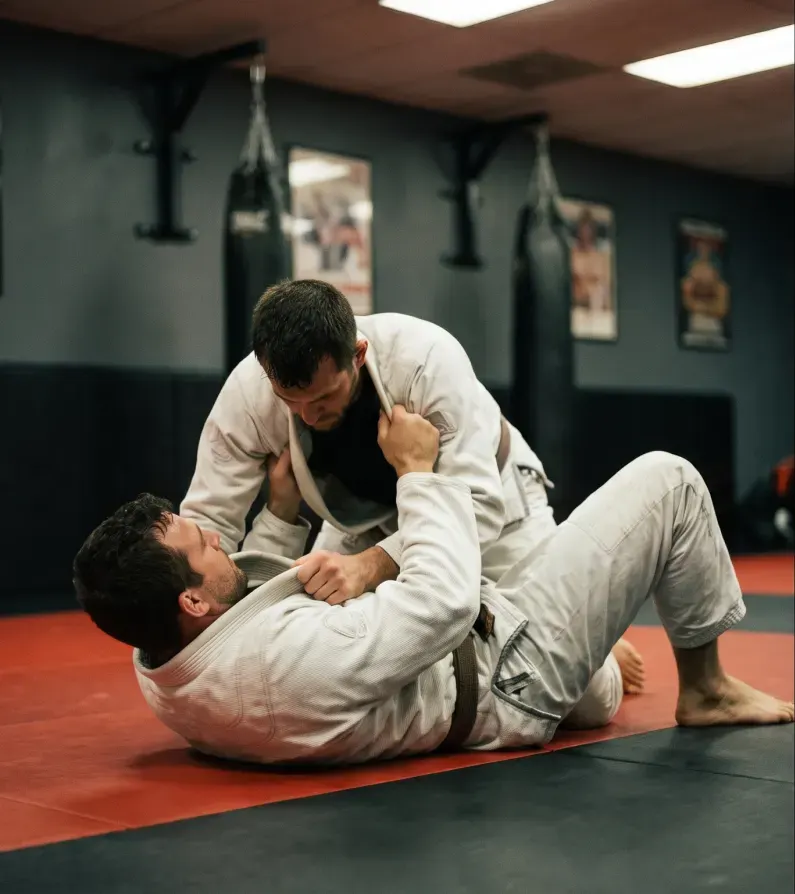
People walk into the gym for a hundred reasons. To learn to defend themselves, to compete, to get their kid off a screen. But a huge chunk of the adults I coach came in for one plain reason: they wanted to get in shape and they were bored to death of the gym. Treadmills, machines, counting reps. It works, and most people quit it anyway.
So the honest question I get all the time is "is jiu-jitsu actually a good workout, or is it just a martial art?" Short version: it is one of the best workouts most people will ever do, and the reason has nothing to do with willpower. Here is how BJJ changes your body, what to expect month by month, and why people who hate exercise keep showing up for this one.
Short answer: is BJJ a good workout?
Yes, and it hits everything at once. A single hour of Brazilian jiu-jitsu trains your heart, your grip, your legs, your core, and your whole back and shoulders, all while you are too busy solving a problem to notice you are exhausted. It is full-body conditioning disguised as a game. Most people who train two or three times a week lean out, get stronger, and sleep better within a couple of months, without ever setting foot on a treadmill.
The trick is that you are not exercising. You are trying not to get your arm bent the wrong way. The workout is a side effect, and that is exactly why it sticks when the gym never did.
What a jiu-jitsu class does to your heart and lungs
BJJ is interval cardio at its rawest. A live round is five or six minutes of scramble, grind, hold, explode, rest for a beat, go again. Your heart rate spikes and drops the same way it does in sprint intervals, which is the kind of cardio that actually moves the needle on conditioning.
Watch a new person in their first hard round and they are blowing after ninety seconds. That is not weakness, it is that grappling demands a kind of fitness the gym never asked of them. The good news is it comes fast. Most people go from gassing out in two minutes to lasting a full round inside six to eight weeks. Nothing on a cardio machine builds that "keep working while tired and thinking" engine the way rolling does.
Does BJJ build strength and muscle?
It builds a specific, useful kind of strength. You are not going to look like a bodybuilder from jiu-jitsu alone, because it is not a hypertrophy program. What you get instead is dense, functional strength: a grip that surprises people, a strong back and posterior chain from constant pushing and bridging, and a core that holds up because you use it in every single position.
New people are always shocked at the muscles that are sore after week one. Forearms, upper back, the sides of the neck, the hips. Those are the "you have never used these the way grappling uses them" muscles. Over months that soreness turns into real, everyday strength, the kind that shows up when you carry groceries or pick up your kid, not just in a mirror.
BJJ for weight loss: what actually happens
People lose weight training jiu-jitsu, but not for the reason they expect. The calorie burn in a hard class is real and meaningful, on par with a solid run for most people. But the burn is not the main lever. Consistency is.
Here is the mechanism I have watched play out a hundred times. Someone starts training three nights a week. They stop skipping workouts, because they are not "working out," they are going to see their training partners and learn a thing they are hooked on. Because they train hard and sleep better, their appetite and cravings settle. Because they do not want to feel heavy and slow on the mat, they start eating a little cleaner on their own, with no one nagging them. The weight comes off as a byproduct of a habit they actually enjoy, and that is the only kind of weight loss that lasts. If your only goal is a number on a scale, jiu-jitsu will get you there sideways, and keep you there.
How BJJ compares to the gym, running, and other workouts
No single activity wins on every axis. Here is the honest trade-off between jiu-jitsu and the workouts people usually weigh it against.
| Workout | Cardio | Full-body strength | Skill you keep | Boredom risk |
|---|---|---|---|---|
| Brazilian jiu-jitsu | High (interval) | High, functional | Self-defense + a lifelong sport | Very low |
| Weight lifting | Low | High, but isolated | None outside the gym | Medium |
| Running | High (steady) | Low | None | High |
| Group fitness / bootcamp | High | Medium | None | Medium |
The column that matters most for staying in shape long term is the last one. The best workout is the one you keep doing. Lifting and running work if you can force yourself to do them for years. Most people cannot. Jiu-jitsu solves the boredom problem by making the workout a puzzle you want to come back and solve, which is why our adult members train for years, not weeks. If you want the whole first-day picture, here is what to expect at your first class.
Do I need to be fit before I start BJJ?
No, and this is the biggest thing holding people back. Nobody arrives in grappling shape, because you cannot build grappling shape anywhere except on the mat. Trying to "get in shape first" is like waiting to learn to swim before getting in the pool.
You start where you are. Early on you drill technique at your own pace, you tap early and often instead of gutting out a bad position, and you sit out a round when you need to. Your conditioning catches up in a few weeks because the training itself is the conditioning. Every out-of-shape beginner who kept showing up got in shape, without exception. If the nerves are the real blocker, we wrote a whole piece for adults with no experience.
Is BJJ safe, or am I going to get hurt?
Trained sensibly, jiu-jitsu is one of the lower-impact martial arts you can pick for fitness. There is no striking in standard BJJ, so you are not taking shots to the head the way you would in boxing or kickboxing. The risk comes from ego, going too hard too early, refusing to tap, muscling out of a submission instead of accepting the tap and resetting.
The way we run class handles most of that. Beginners drill more and roll lighter, we pair you with people who control the pace instead of trying to smash you, and the number one rule is that tapping is free. A tap costs you nothing and teaches you something. That is why plenty of people in their forties and fifties train comfortably for years. If age is your worry, we covered it in starting martial arts after 50.
How often should I train BJJ to get in shape?
Two to three classes a week is the sweet spot for fitness. Two keeps you moving forward and gets you real conditioning gains. Three is where most people see their body change noticeably, cardio, strength, and weight all shifting inside a couple of months, while still leaving recovery days.
Once a week is fine to learn and enjoy it, but you will not get the fitness transformation, because you are not on the mat enough for your body to adapt. More than four times a week is great once you are conditioned, but brand-new bodies need the recovery, so ramp up over months, not in week one. If you want to see when our classes run, here is the full schedule across our Northern Virginia academies.
The part the gym can't give you
Here is what I care about most. A treadmill will never make you show up on a night you are tired. A machine does not notice if you skip. Jiu-jitsu does both, because there are people waiting to train with you, a skill pulling you back, and small wins every single week that have nothing to do with a scale. That is the whole secret to why it works as fitness when nothing else did. You stop needing discipline, because you are not making yourself exercise anymore. You are just going to do the thing you like, and the fitness follows.
If you have been trying to get in shape and hating every minute of it, come try a class. Watch a round, get on the mat, feel what an hour of it does. We loan you a gi, we pair you with someone who will teach instead of crush you, and you find out for yourself. The cleanest next step is to book a free class, look at the BJJ program, or if you are brand new, start with our guide to BJJ for beginners. And if you are weighing the budget, here is what BJJ actually costs per month.
Common questions about BJJ for fitness
Is BJJ a good workout for weight loss?
Yes. A hard class burns calories on par with a solid run, but the real reason people lose weight is consistency. They stick with training because they enjoy it, sleep and eat better as a result, and the weight comes off as a byproduct of a habit they actually keep.
Can I do jiu-jitsu if I'm out of shape?
Absolutely, and almost everyone starts that way. You cannot build grappling conditioning anywhere but on the mat, so you start where you are, drill at your own pace, tap early, and rest when you need to. Your fitness catches up within a few weeks because the training itself is the workout.
How many times a week should I train BJJ for fitness?
Two to three times a week is the sweet spot. Two keeps you progressing, three is where most people see their body change in a couple of months, and both leave room for recovery. Once a week is fine to enjoy it but too little for a real fitness change.
Is BJJ safe for fitness, or will I get hurt?
Standard BJJ has no striking, so it is one of the lower-impact martial arts for fitness. Most injuries come from ego and refusing to tap. When you train light early, pick good partners, and tap freely, plenty of people train safely into their forties, fifties, and beyond.
Will jiu-jitsu build muscle?
It builds functional strength more than size, a strong grip, back, and core from constant pushing, bridging, and holding position. You will get denser and stronger and notice muscles you never used, but for pure size you would pair it with some lifting.