
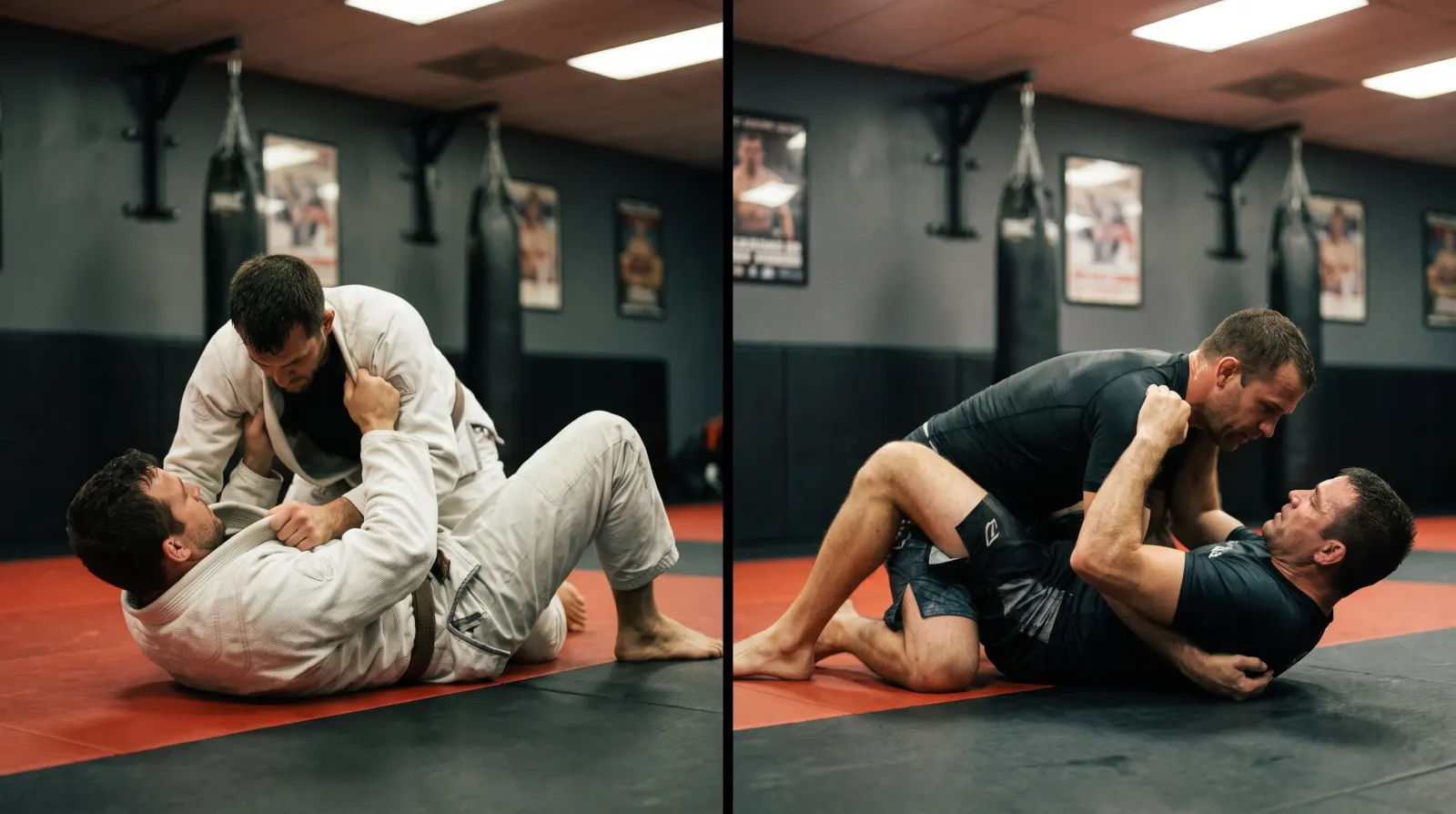
If you've looked into starting Brazilian jiu-jitsu, you've run into the two versions almost immediately. There's the one in the pajama-looking uniform, and the one in the fitted shirt and shorts. Gi and no-gi. People treat it like a big decision, and I get why, but it's a smaller fork than it looks. It's the same art. You're still learning to control someone and finish the match without throwing a punch. The uniform just changes what you can grab.
Short version, and then I'll break it all down: the gi is the better classroom for a beginner because it slows the game down and forces good technique, and no-gi is closer to what a real scramble or an MMA fight feels like. Most people who train a while end up doing both. Here's how they actually differ, which one to start in, and how we'd get you going in Northern Virginia.
What is the actual difference between gi and no-gi BJJ?
The gi lets you grip clothing, and no-gi doesn't. That single rule changes almost everything about how the two feel. In the gi you wear a heavy cotton jacket, pants, and a belt, and you're allowed to grab any of it, your opponent's collar, their sleeve, their pants. Those grips let you control and stall and set up chokes that use the fabric itself. In no-gi you wear a rash guard and shorts, and there's nothing to hold onto but the body, so you control with underhooks, wrist grips, and head position instead. The gi game is slower, grippier, and more about patience. No-gi is faster, sweatier, and more about speed and scrambling because your partner keeps slipping out of your hands. Same positions, same goal, different set of handles.
Gi vs no-gi at a glance
Here's the honest side-by-side I give new people on the mat when they ask which to try first. Neither column is better. They reward different things.
| Gi | No-gi | |
|---|---|---|
| What you wear | Heavy cotton jacket, pants, belt | Rash guard and shorts |
| What you grip | The uniform plus the body | The body only |
| Pace | Slower, grippy, methodical | Faster, slippery, scramble-heavy |
| Rewards | Patience and precise technique | Speed, timing, athleticism |
| Submissions | Adds collar and sleeve chokes | Leans on the neck and legs |
| Ranked by | Belt system you wear on the mat | Usually same belt, no gi to show it |
| Closest to | Classic sport jiu-jitsu | MMA and real scrambles |
| Best first for | Most beginners | Athletes and MMA-focused folks |
Which should a beginner start with?
Start in the gi if you have the choice, because it teaches cleaner jiu-jitsu faster. The gi slows everyone down. Your training partner can grab your collar and pin you in place, so you can't just muscle or speed your way out the way a strong, athletic beginner tends to. That's a good thing when you're learning. It forces you to solve the problem with position and leverage instead of a scramble, and that's the actual skill of jiu-jitsu. A lot of coaches, me included, believe the gi builds a more patient, more technical base, and that base carries straight over to no-gi later. The trade is that the gi has more little details to learn (all those grips), so the first month can feel busier. If your class only offers no-gi, don't worry about it for a second, you'll still learn plenty. But if both are on the schedule and you're brand new, I'd point you at the gi first. Either way the very first session looks the same, and we walk through it in what to expect at your first class and our guide to BJJ for beginners.
Does gi or no-gi make you better faster?
The gi tends to build technique faster, and no-gi tends to build usable speed and scrambling faster. Because the gi bogs the pace down, you're forced to learn the precise mechanics of an escape or a sweep, and there's an old saying in jiu-jitsu that training in the gi and then taking it off feels like someone unlocked fast-forward. On the flip side, no-gi throws you into faster exchanges from day one, so your reactions, your timing, and your comfort in a chaotic scramble sharpen quickly. Neither is a shortcut. The people who improve fastest are usually the ones who show up consistently, three-ish times a week, and pay attention, and that's true in both. If your only goal is clean, transferable technique, the gi has a slight edge as a teacher. If you want to feel athletic and dangerous in a hurry, no-gi delivers that feeling sooner.
Which is better for self-defense?
No-gi is a touch more realistic for a street situation, but honestly both give you the thing that matters most. In real life nobody's wearing a thick cotton jacket you can grab, so the no-gi habit of controlling a sweaty, squirming body with underhooks and head position maps more directly onto a scuffle. That said, the core self-defense value of jiu-jitsu, the part that actually keeps a normal person safe, is the same in both: learning to stay calm on the ground, protect yourself, control a bigger person, and end the situation without trading punches. A gi practitioner who's drilled thousands of reps has that skill too. There's even an argument that a real attacker often is wearing a jacket, a hoodie, a shirt you can grab, so gi grips aren't useless on the street. If self-defense is your main reason for training, either one works, and we cover the bigger picture in the best martial arts for self-defense.
Which is better for MMA?
No-gi is the clear pick if MMA is your goal, because nobody fights in a gi. In the cage you're grappling a sweaty opponent with small gloves on, so the grips, the pace, and the scramble of no-gi are exactly what you need, and the leg locks and body-lock control that no-gi leans on show up constantly in modern MMA. Training gi won't hurt your MMA game, plenty of great grapplers have a strong gi background and credit it for their patience and their guard, but if you have limited time and MMA is the target, spend most of it in no-gi and add wrestling and striking. Grappling is only one piece of the mixed-martial-arts puzzle, and we lay the whole thing out in MMA vs boxing vs BJJ and BJJ vs wrestling.
Do you need to train both?
You don't need to, but doing both makes you a more complete grappler, and most people who stick with jiu-jitsu drift into training both anyway. Each one patches the other's weak spot. The gi keeps your technique honest and gives you a huge toolbox of grips and chokes. No-gi keeps you fast, tests whether your technique holds up when there's nothing to hold, and preps you for MMA or a real scramble. A lot of our members do a couple gi classes and a couple no-gi classes a week and don't overthink which is which, they're just training jiu-jitsu. You do not have to pick one forever. Start where it makes sense for you, get comfortable, and add the other when you're curious. The belt you earn counts in both, and if you're curious how that ranking works, we walk through the whole BJJ belt system and timeline.
What do you wear for gi vs no-gi?
For gi you need an actual jiu-jitsu gi and a belt, and for no-gi you need a rash guard and shorts, and that's basically it. A BJJ gi is tougher than a karate uniform and runs anywhere from around eighty to a couple hundred dollars, but here's the beginner tip: don't buy one for your first class. We loan you a gi so you can try jiu-jitsu before you spend a dime, and I'd wait until you've trained a few weeks before buying your own, because a brand-new person often picks the wrong size or style and gets discouraged. For no-gi, wear a rash guard (not a loose cotton t-shirt, it gets grabbed, stretched, and gross) and grappling or athletic shorts without pockets or zippers. Bring a mouthguard for either. We break gear down further in our guide for adults with no experience.
Where to start jiu-jitsu in Northern Virginia
The fastest way to know which one fits you is to feel both, and you can do that on a free trial with us. At Kaizen we teach jiu-jitsu across our Northern Virginia academies, and if you're brand new we'll get you started right, gi loaned, no pressure, at a pace you can handle. My honest advice stands: if the schedule offers both and you're just beginning, start in the gi to build clean technique, then try no-gi once you've got your feet under you. If you already know MMA is the goal, lean no-gi. Either way, one class tells you more than a month of reading about it. Come try a free class, check the schedule, look at our BJJ program, and if your kid's the one interested, we run kids BJJ in Northern Virginia too. Still deciding between grappling and striking? Start with Muay Thai vs BJJ.
Frequently asked questions
Should a complete beginner start with gi or no-gi?
Start with the gi if both are available. The gi slows the pace down and stops you from muscling out of positions, which forces you to learn real technique instead of relying on speed and strength. That base carries straight over to no-gi later. If your class only offers no-gi, that's completely fine too.
Is gi or no-gi harder?
They're hard in different ways. The gi has more to learn early because you're managing all the grips, so it can feel busier at first. No-gi is more physically demanding in the moment because everything moves faster and your partner keeps slipping out of your control. Beginners often find the gi more forgiving to learn in.
Can you switch between gi and no-gi?
Yes, and most people do. It's the same art with the same positions, so your jiu-jitsu carries over both directions. The belt you earn counts in both. Many of our members train some gi and some no-gi in the same week without thinking twice about it.
Do I need to buy a gi for my first class?
No. We loan you a gi for your first class so you can try jiu-jitsu before buying anything. We'd actually suggest waiting a few weeks before you buy your own, since brand-new students often pick the wrong size or style. For no-gi, just bring a rash guard and athletic shorts.
Which is better for MMA, gi or no-gi?
No-gi, clearly, because MMA is fought without a gi. The pace, the grips, and the scrambles of no-gi match what happens in the cage, along with the leg locks and body-lock control it emphasizes. Training gi still helps your technique and patience, but if MMA is your goal, spend most of your grappling time in no-gi.