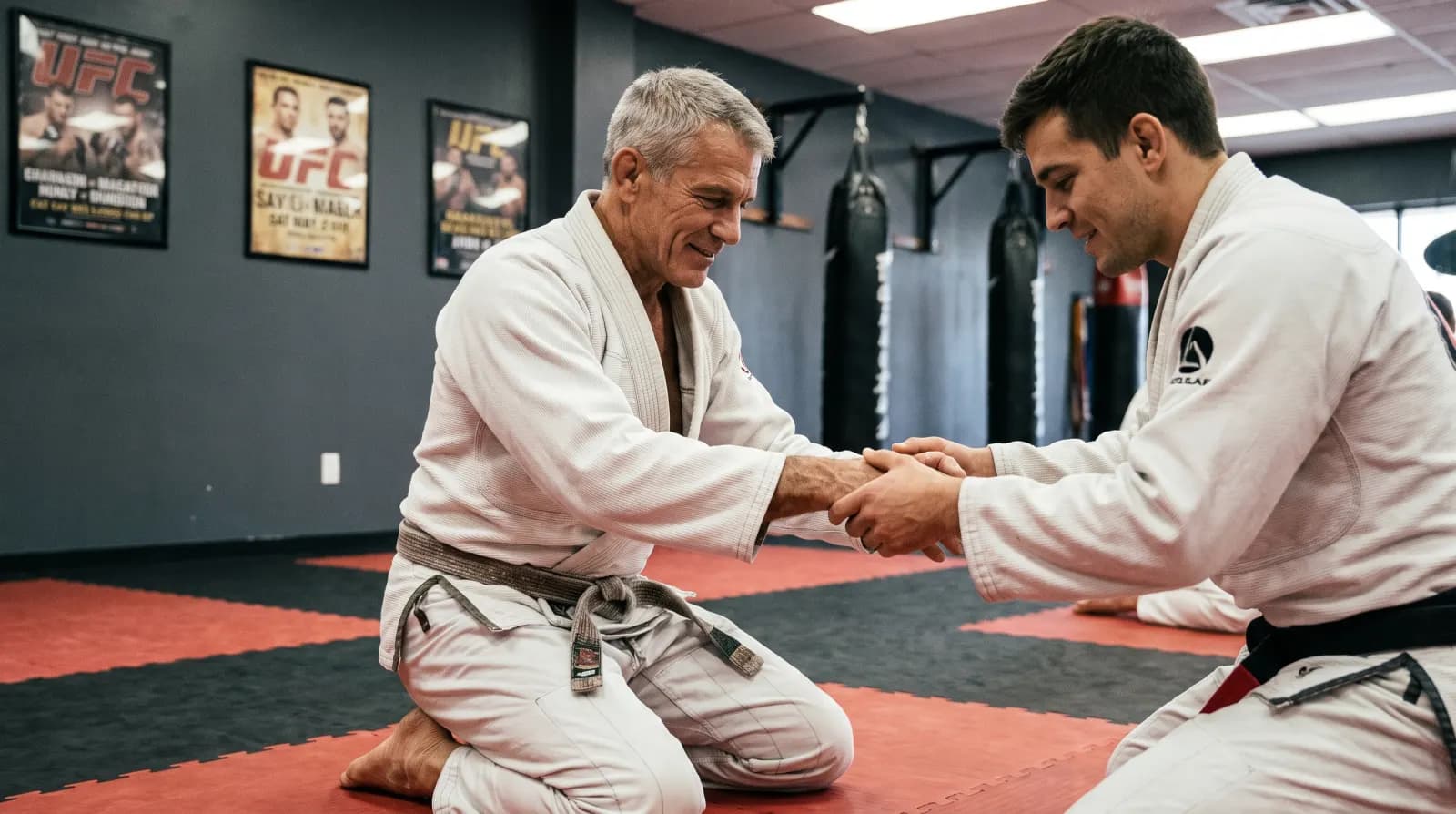
I've been coaching for over twenty years, and the person I get most excited to see walk in isn't the twenty-two-year-old athlete. It's the fifty-eight-year-old who's been thinking about this for a decade and finally showed up. They almost always open with the same worried line: "I'm probably too old for this, right?" No. You're not. I've helped plenty of adults start in their fifties and sixties, and the ones who train smart are still on the mat years later, moving better than they did the day they walked in.
The honest version is this: starting martial arts as an older adult isn't about keeping up with the young athletes. It's about picking the right style, the right class, and the right pace, then letting the training meet you where your body actually is. Done that way, it's one of the best things you can do for your joints, your balance, your stress, and your head. Here's how to start after 50 without getting hurt.
Are you too old to start martial arts?
No. There is no age where it stops being worth it, as long as you train at a gym that will adjust the intensity for you. Martial arts is not a single fixed activity you either can or can't survive. It's a set of skills you can drill at almost any speed, from a slow technical crawl to a hard competitive pace. An older beginner runs the exact same first drills as a younger one, just with more warm-up, more rest, and no pressure to spar. What actually stops most older adults isn't their age. It's picking a gym that only trains one gear (all-out) and then quitting in week two because it hurt. Pick the right room and the age stops being the issue.
Which martial arts are best for older adults?
For most people over 50, jiu-jitsu and boxing are the friendliest places to start, with Muay Thai a solid option if your knees and hips feel good. The deciding factor is how much impact the style puts on your body and how much you can control the pace. Here's how the main options stack up for an older beginner.
| Style | Why it suits older adults | Watch out for |
|---|---|---|
| Brazilian jiu-jitsu | Low impact, technical, you can tap the second anything feels wrong, works even off your back | Finger and knee wear over years; skip hard rolling early |
| Boxing | Great cardio and coordination, mostly bag and pad work, no takedowns | Wrist and shoulder strain if you skip the wraps and warm-up |
| Muay Thai / kickboxing | Full-body conditioning, footwork, and mobility on the pads | Higher knee and hip demand; go pad-only, no hard sparring |
| Wrestling | Elite conditioning and balance | Highest impact of the group; usually not the first pick after 50 |
If I had to point one older adult at one thing, it'd usually be jiu-jitsu, because so much of it happens on the ground at a pace you control. Boxing is the close second when someone wants cardio and stress relief without anyone touching them. If you're weighing the grappling-versus-striking question, our Muay Thai vs BJJ breakdown walks through the trade-offs, and MMA vs boxing vs BJJ covers all three side by side.
Is BJJ safe for seniors and people over 40?
Yes, jiu-jitsu is one of the safest martial arts for an older body, which is exactly why so many people over 40 pick it and stick with it for decades. The reason is simple: in BJJ you can tap out the instant something feels wrong, and a good training partner lets go immediately. Nobody is throwing punches, nobody is slamming you, and the whole point of the sport is control, not damage. You can slow a roll down to a technical crawl, sit out anything that feels off, and build capacity month by month. The wear that does add up over years tends to be fingers and knees, and you manage that by warming up properly and not going hard before your body is ready. For a beginner-friendly picture of how a first BJJ class actually runs, see our guide to BJJ for beginners. The short version: it's slow, technical, and nobody is trying to hurt you.
What older adults should skip in the first month
In month one, skip live sparring, hard rolling, and any drill that has you moving explosively before you're warm. The mistake I see older beginners make isn't training too little, it's trying to prove something in the first few weeks and tweaking a shoulder or a knee that then keeps them home for a month. Your first weeks are for learning the shapes of the movements, building a base of conditioning, and letting your joints adapt. That means fundamentals classes over competition classes, positional drilling over full-speed rolling, pad work over sparring, and always tapping or stepping out early rather than late. There's no medal for gutting through a round that your body is telling you to stop. The people who last are the ones who train boring and safe for the first month, then earn the harder stuff. This is the same on-ramp we give every nervous adult beginner, which we lay out in martial arts for adults who've never trained.
How to scale up over your first 90 days
Give yourself three months to go from careful newcomer to comfortable regular, and let each phase earn the next. Rushing this is how people get hurt; respecting it is how they stay. Here's the arc I'd hand an older beginner.
| Phase | What you're doing |
|---|---|
| Weeks 1 to 2 | Fitness and fundamentals only. No sparring or hard rolling. Learn the warm-up, the basic positions, how to fall and how to tap. |
| Weeks 3 to 6 | Add light positional drilling with a controlled partner. Still no all-out sparring. Your conditioning starts to catch up. |
| Weeks 7 to 12 | If your body feels good, add light structured rolling or controlled pad rounds. You choose the intensity, and you can always dial it back. |
The pace is yours the whole way. If week 6 is still hard, stay in week-3 mode longer. Nobody at a good gym is pushing you up the ladder faster than your body wants to go.
Which class times work best for older beginners?
Morning and midday classes usually skew calmer and more technique-focused, which makes them the easier on-ramp for an older adult. Evening classes fill up with people burning off the workday, so the energy runs higher and the rolling can get spirited. That's not a rule, it varies by location and by day, but if you want a gentler introduction, the earlier slots are often where you'll find a smaller group, more coach attention, and training partners who are there to drill rather than compete. The best move is to just ask us. Tell us your goals and any old injuries and we'll point you to the class times at your nearest location that fit an older beginner best. You can browse the current class schedule to see what's running near you.
What we actually see with adults over 50 on the mat
The older adults who train with us don't come in to become competitors, and that's a big part of why it works so well for them. They come in for their knees, their stress, their balance, and honestly for the community. What I watch happen over a few months is real: they move better, they sleep better, they carry themselves differently, and they end up with a group of training partners across every age who look out for them. Grappling and striking build a kind of body awareness and problem-solving that a treadmill never will, and it's genuinely fun in a way that keeps people coming back when a gym membership would've been abandoned by February. I've got adults well into their sixties who train a few times a week and are in better shape than people twenty years younger. It's never a young person's activity only. It just needs to be trained like an adult with a life to protect, which is exactly what we coach.
How to start martial arts as a senior in Northern Virginia
The best first step is to come watch or try one beginner class, tell the coach your age and any injuries, and let us build the on-ramp around you. We teach jiu-jitsu, boxing, Muay Thai, and more across our Northern Virginia academies, and every location runs fundamentals classes where an older beginner fits right in. You don't need to be fit to start, you don't need any experience, and you will never be pushed into sparring before you're ready. Come try a free class, check the schedule at your nearest location, and take a look at our BJJ and boxing programs to see where you'd like to begin. If you're an older adult who's brand new to all of this, our guide to training as an adult with no experience is the honest place to start reading.
Frequently asked questions
Is 50 too old to start jiu-jitsu?
No. Fifty is a common age to start BJJ, and it's one of the best martial arts for older adults because you control the pace and can tap out the instant anything feels wrong. Begin in fundamentals classes, skip hard rolling for the first month, and build up gradually. Plenty of people start in their fifties and train for years.
What is the safest martial art for seniors?
Brazilian jiu-jitsu is usually the safest starting point because it's low impact and you can stop any exchange immediately. Boxing is a close second since it's mostly bag and pad work with no takedowns. Both let an older adult build fitness without the higher-impact demands of wrestling or full sparring.
Do I need to be in shape before I start?
No. Getting in shape is what the training is for, not something you do beforehand. Every class scales to your level, so you go at your own pace, take water breaks whenever you need them, and sit out anything that feels wrong. You'll be a little sore the first couple of weeks, then your body adapts.
Can I train with an old injury or joint problem?
Often yes, but tell your coach about it before class so we can adjust the drills and steer you away from anything that aggravates it. For anything serious, check with your doctor first. Most older adults train around old knees, shoulders, and backs just fine once we know what to protect.
How often should an older adult train?
Two to three times a week is a great starting rhythm for most older beginners. It's enough to build skill and conditioning while leaving plenty of recovery between sessions, which matters more as you get older. You can always add days once your body has adapted, but there's no need to rush it.