
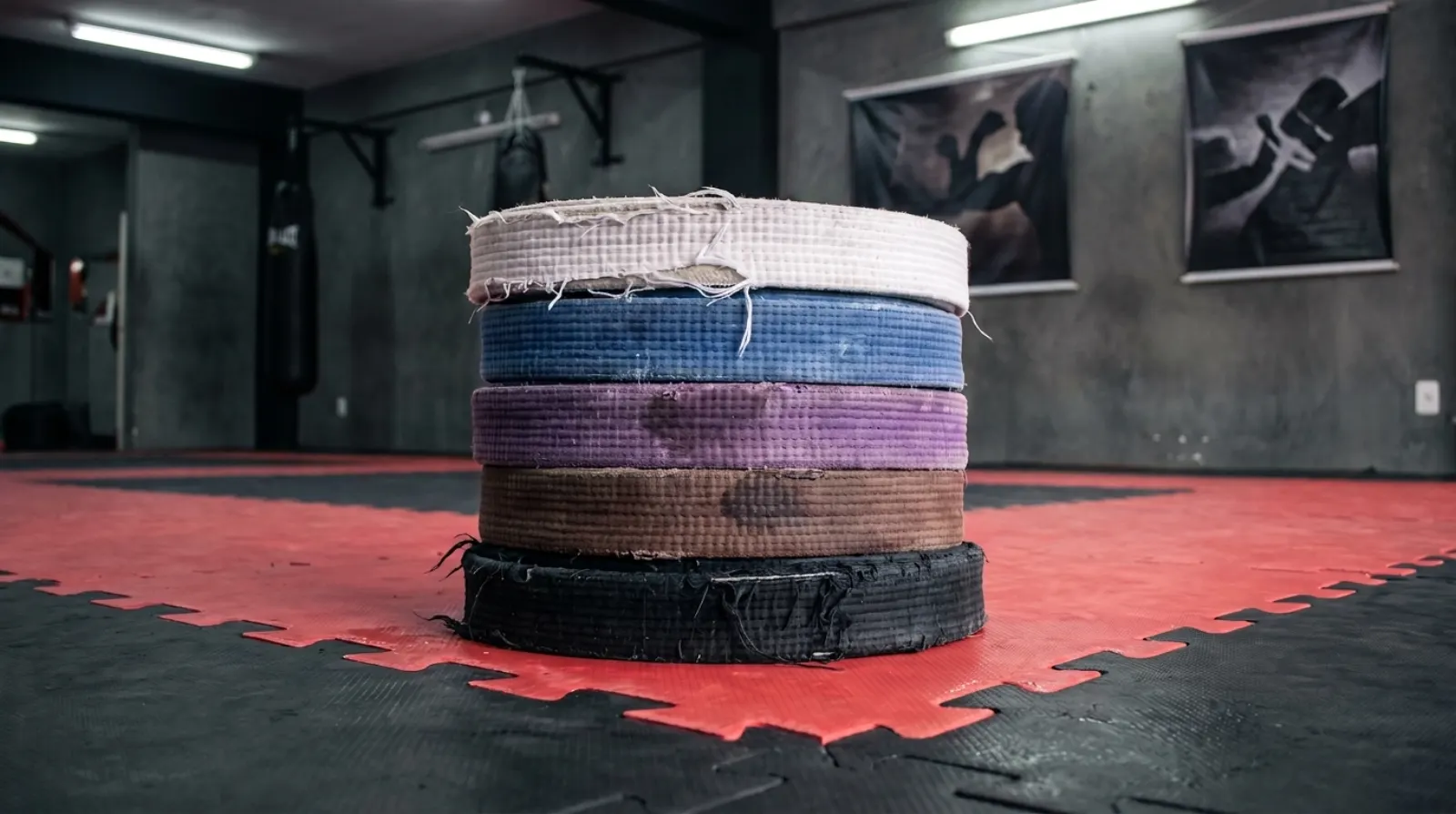
Every few weeks someone new asks me the same thing after class: "Coach, how long until I get my blue belt?" It's a fair question, and I get why people fixate on the belts. They're the one visible marker of progress in a sport where you spend the first year mostly getting tapped. So let me walk you through the whole system, honestly, and then tell you the part most gyms skip: the belt is a byproduct, not the goal.
Short version: adult BJJ goes white, blue, purple, brown, black, with four stripes earned on each belt along the way. Getting to black belt takes most people around ten years of consistent training. Kids have their own colored-belt path until they're old enough to enter the adult ranks. Here's how all of it actually works.
What is the BJJ belt order for adults?
The adult Brazilian jiu-jitsu belt order is white, blue, purple, brown, then black. Everyone starts at white, no matter how athletic you are or what other martial arts you've done. From there you climb one belt at a time, and most people wear each belt for a couple of years before the next one. It's a slow system on purpose. Beyond black there are two more ranks that almost nobody outside a lifelong instructor ever sees: the coral belt (red and black) and the red belt, which are reserved for decades of contribution to the art. For the vast majority of people who train, black belt is the summit, and it's a long climb to get there.
The BJJ belts at a glance, and how long each takes
Here's the honest breakdown I give people when they ask about the timeline. These are typical ranges across the sport, not a promise. Your pace depends on how often you show up, your body, and your coach's standards.
| Belt | What it means | Rough time at this belt |
|---|---|---|
| White | Complete beginner. Learning to survive and not panic. | 1 to 2 years |
| Blue | You know the fundamentals and can defend yourself on the mat. | 2 to 3 years |
| Purple | Advanced. Your game is your own and you can teach beginners. | 1.5 to 2 years |
| Brown | Refining and sharpening. Close to expert. | 1 to 2 years |
| Black | Expert and instructor level. The start of real mastery, not the end. | Years, then coral and red beyond |
Add it up and the total from white to black is usually around ten years for someone training a few times a week. Some people are faster, plenty are slower, and both are completely normal.
What do the stripes on a BJJ belt mean?
The stripes are the smaller checkpoints between belts. You can earn up to four stripes on each belt before you're promoted to the next color, and they're your coach's way of saying "you're making progress, keep going." A white belt with two stripes has clearly put in real time and picked up real skill, even though the belt color hasn't changed yet. Not every gym uses stripes the same way, and some don't stress them at all, but the idea is universal: they break a two-year belt into bite-sized wins so you can feel yourself moving forward instead of staring up at a mountain. When people get frustrated about the pace, I point at the stripes. That's the progress, right there.
How long does it really take to get a blue belt?
For most adults training two or three times a week, a blue belt takes somewhere between one and two years. Blue is the first big milestone, and it's meaningful. It roughly means you've stopped being a total beginner, you can survive against untrained people, and you understand the basic positions and escapes. There's no test you cram for and no fixed calendar. Your coach watches how you move, how you handle pressure, whether your fundamentals hold up when someone's actually trying to beat you, and promotes you when you're ready. The honest truth about blue belt is that it's also where the most people quit, often right before they'd have earned it. If you can push through that first stretch, you've cleared the hardest part.
How does the kids belt system work?
Kids have their own belt path because it wouldn't make sense to put a seven-year-old on the same ten-year adult timeline. The youth system runs through white, grey, yellow, orange, and green belts (each with its own solid, striped, and darker variations), covering roughly ages four through fifteen. It gives kids more frequent, more visible steps, which matters a lot for keeping a young kid motivated. When a teenager gets old enough, those kids ranks convert into the adult system, usually landing them somewhere in the white-to-blue range rather than skipping ahead. We run kids grappling across our academies, and if that's who you're asking for, our guide to kids BJJ in Northern Virginia covers what a class actually looks like.
Why mat time matters more than the belt color
Here's the part I care about most. The belt is not the point, the training is. I've rolled with plenty of fresh blue belts who were tougher than some purple belts from other gyms, because belts only mean as much as the standard behind them and the hours you've genuinely put in. A belt you're handed too early doesn't make you better, it just makes the number on your waist a lie your body can't back up. The people who improve fastest are never the ones counting the days to their next promotion. They're the ones who show up three times a week, drill the boring stuff, lose to better training partners, and come back. Do that, and the belts take care of themselves. Chase the belt instead of the skill, and you'll get neither. And unlike a lot of martial arts, none of those promotions come with a testing fee, so your monthly tuition is basically the whole bill. If you're just starting out, our honest walkthrough of BJJ for beginners, what to expect at your first class, and how much BJJ costs per month will tell you more than any belt chart.
Do belts carry over between gi and no-gi?
Yes. The belt you earn is a rank in jiu-jitsu itself, not in one uniform, so it counts whether you're training in the gi or in a rash guard for no-gi. You wear the physical belt in the gi and simply carry the same rank without it in no-gi. It's the same art with the same positions either way, which is exactly why the rank travels. If you're still deciding which version to start with, we broke that down in gi vs no-gi BJJ. And if you're weighing jiu-jitsu against other grappling arts, BJJ vs wrestling and Muay Thai vs BJJ lay out the trade-offs.
Start your own BJJ journey in Northern Virginia
The belt system looks intimidating from the outside, but nobody's thinking about black belt on day one, and neither should you. You're thinking about surviving the first class, then the first month, then earning that first stripe. That's how everyone who ever tied on a black belt started, white belt, no idea what they were doing, tapping constantly. At Kaizen we teach jiu-jitsu across our Northern Virginia academies, we loan you a gi for your first class, and we promote people on real skill, not on a schedule. Come try a free class, look at the schedule, and check out our BJJ program. If you've never trained anything before, start with our guide for adults with no experience, or if you're weighing the budget first, here's what BJJ actually costs per month. One class tells you more than a year of reading about belts.
Frequently asked questions
What is the order of BJJ belts?
For adults it goes white, blue, purple, brown, then black. Beyond black are the coral belt (red and black) and the red belt, but those are reserved for lifelong instructors and take decades. Everyone starts at white, and you earn up to four stripes on each belt before moving to the next color.
How long does it take to get a BJJ black belt?
Around ten years of consistent training for most people, though it varies widely. There's no fixed timeline. It depends on how often you train, your coach's standards, and your own body. The people who get there aren't the fastest, they're the ones who kept showing up for a decade.
How long does a blue belt take in BJJ?
Usually one to two years for an adult training two or three times a week. Blue belt roughly means you've cleared the beginner stage and can hold your own. It's also the belt most people quit right before earning, so pushing through that first stretch is the hardest and most important part.
What do the stripes on a BJJ belt mean?
Stripes are the smaller checkpoints between belts. You can earn up to four on each belt before being promoted to the next color. They're your coach's way of marking real progress so a two-year belt feels like a series of wins instead of one long wait.
Do kids earn the same belts as adults?
No. Kids have their own system, white, grey, yellow, orange, and green, covering roughly ages four to fifteen, with more frequent steps to keep young kids motivated. When a teen gets old enough, those ranks convert into the adult white-to-blue range rather than skipping ahead.