
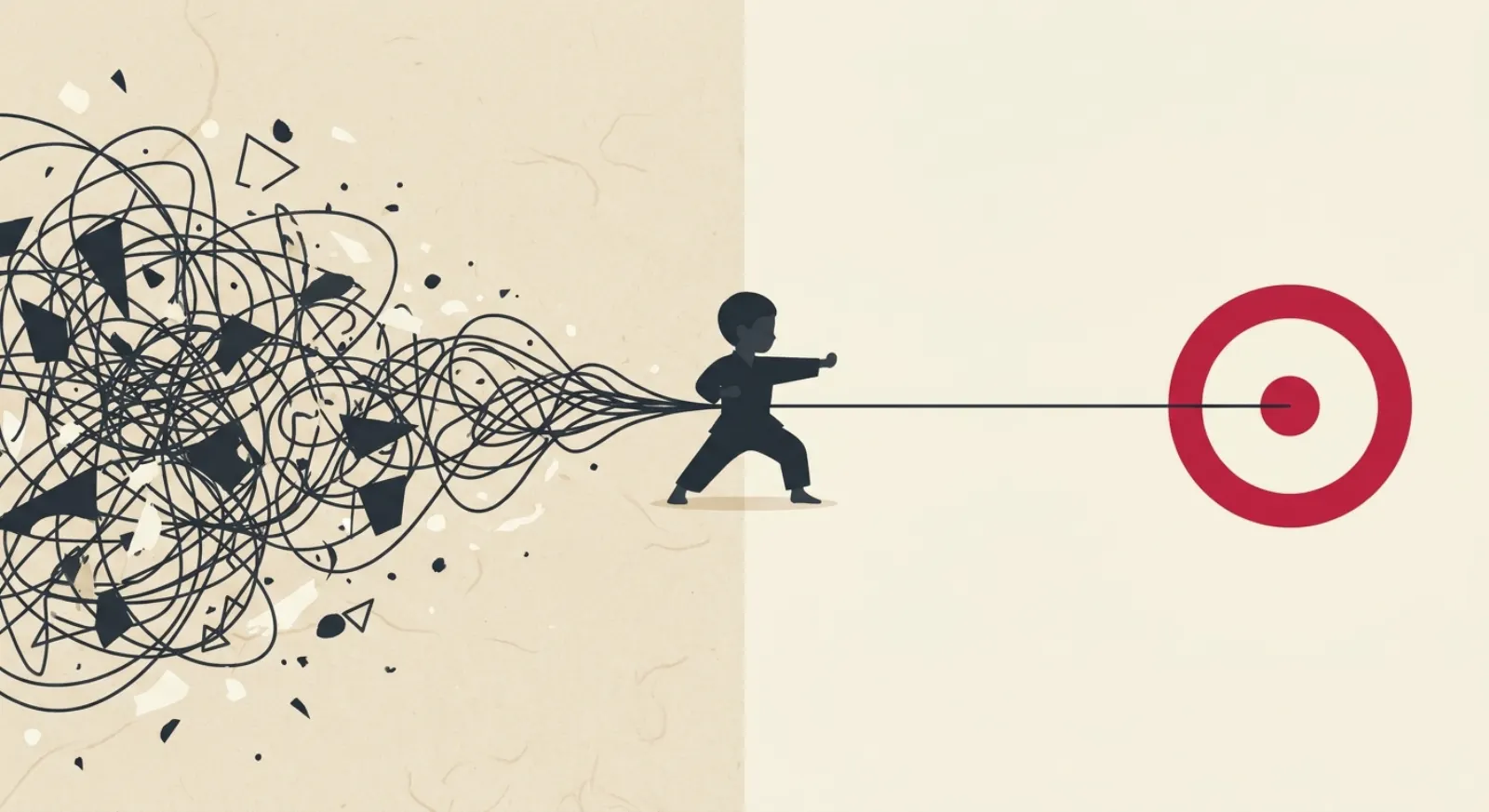
Most parents who reach out about an ADHD kid are tired. They've tried soccer that ended in tears on the bench, swim that he ditched after a month, and the after-school pickup line where the teacher does the slow head-shake. They want a place that finally clicks. The fair question is whether martial arts is actually that place, or just another activity their kid will rage-quit by week 4.
The honest answer, after years of coaching kids with ADHD across our gyms, is that martial arts fits a lot of these kids better than the standard youth activities for reasons that aren't obvious. It also has parts that are genuinely hard for them. Here's what we actually see, why it works, what's tough, and how a parent can tell if it's the right call for their specific kid.
Quick answer: does martial arts actually help kids with ADHD?
Yes, for most kids, when it's coached right. Martial arts gives an ADHD brain three things it doesn't usually get in one place: short drilled reps that match a short attention span, immediate physical feedback on whether something worked, and a belt system that turns slow progress into something a kid can see. We aren't saying it's a treatment or a substitute for what a doctor recommends. We're saying that out of all the after-school activities a parent can try, this one has structural features that fit how an ADHD kid actually operates. Some kids click in the first class. Some take a month. Almost none of them are still in it for the wrong reasons by month 3.
Why martial arts fits an ADHD brain better than most kids activities
The short version is that martial arts is built out of short reps, and most other kids activities aren't.
Think about what a typical 60-minute kids martial arts class looks like. The coach demonstrates one small thing for 30 seconds. The kid drills it for 90 seconds. Coach corrects. Drill again. A quick game that's really a reset. New small thing. Repeat. The longest single block of standing-and-listening is usually under a minute. For a kid whose attention span runs in 90-second chunks before the brain wanders, that structure is friendly by default. Compare that to a soccer practice where a 7-year-old stands in left field for ten minutes waiting for a ball that may never come, and you can see why the rage-quit rate is different.
Three more things go in our favor:
- Physical feedback is immediate. When a kid throws a jab and the pad pops, or sets up a takedown and lands it, the brain gets the reward right there. No waiting on a coach to praise something abstract. The activity itself tells the kid it worked.
- The belt system externalizes progress. Kids with ADHD often struggle to remember they're getting better because last week feels like last year. A stripe on the belt is something concrete to point at. Some weeks they can't see growth on their own. The belt is the receipt.
- One-on-one correction beats a 20-kid sideline. Coaches in a good kids program circulate constantly. A kid who would coast unnoticed in a big team gets touched by a coach 8 to 12 times in an hour. That's the level of feedback most ADHD kids need.
What we actually see in the first 3 months with an ADHD kid on the mat
Every kid is different, but there's a pattern we see often enough to write it down.
| Timeline | What usually happens in class | What parents notice at home |
|---|---|---|
| Week 1 to 2 | Big highs, a few meltdowns. The kid is overstimulated. Some classes are great, some they can't get through the warm-up. | Same kid as always, just tired. Often sleeps better that night. |
| Week 3 to 6 | The novelty fades and the kid has to actually drill. This is where some kids want to quit. The ones who push through usually start landing real technique. | "I don't want to go" comes up. Parents who hold the line through this window almost always thank us later. |
| Week 7 to 12 | Real progress. The kid can hold position for a longer rep, takes correction without falling apart, and starts asking when the next class is. First stripe usually lands here. | Better focus on homework. Less escalation at the dinner table. Teachers sometimes notice. |
We aren't promising a transformation. We're describing what we watch happen, in real kids, on a real mat, with parents who reported ADHD diagnoses or strong ADHD traits at intake. The kids who get the most out of it are the ones whose parents knew month 1 would be bumpy and stayed the course.
Where it's hard: the parts of class that don't come easy
The bow-in, the listening, and the standing-in-line bits are the hard parts. We won't pretend otherwise.
Every kids class has a few minutes of "everyone sit down and listen" at the start and end. For an ADHD kid, that's the longest minute of the day. Our coaches plan around it. We keep those segments short, we use movement to bookend them, and we pair an antsy kid with a coach's eye contact instead of expecting them to self-regulate. Even with all that, some weeks the bow-in is messy. That's normal. The kid is not failing martial arts. The class is not failing the kid. It's the part of the work that takes the longest to come.
The other genuinely hard piece is partner work where the partner is goofing off. Kids with ADHD feed off other kids with ADHD. We handle this by pairing thoughtfully, not by accident. If the pairing isn't working, we change it within the round. Parents should expect us to do this, and they should tell us at intake if their kid is the one who escalates fast in those moments.
How our coaches run a class for a kid who can't hold still yet
The plan is small chunks, lots of touches, and a coach who notices early.
For a brand-new ADHD kid in Little Lions or Young Lions, we run a specific playbook the first month. We keep technique reps to 30 to 60 seconds, then move. We catch the kid early when they're starting to drift, not after they've already bolted across the mat. We give them a job during transition moments (carry the pads, demo for a partner, count for the group) so the brain has a task during the gaps where attention usually falls off. And we try to make sure the first stripe or the first real "got it" moment lands before week 6 so the kid has a win to hang onto when the novelty drops.
Coaches who know the kid by name and know their parents by name are the difference. The relationship is what makes the harder weeks survivable.
Which martial art tends to fit an ADHD kid best
Grappling first for most ADHD kids. Striking later, or alongside.
This is a personal read built on watching a lot of kids, not a rule. Brazilian jiu-jitsu and wrestling tend to suit ADHD kids well because they're constant problem-solving with a partner. The kid is moving, thinking, and adjusting all at once. There's no standing still waiting for a turn. The feedback loop is immediate and the kid has to focus on the person right in front of them. Muay Thai on pads is great for the high-energy kid who needs to hit something, but the standing-and-watching segments of a striking class can be tougher in month 1.
For most ADHD kids we'd start with the mixed kids program (which weaves in BJJ, Muay Thai, and wrestling) and let the kid gravitate toward what clicks. By month 3 the answer is usually obvious. If wrestling is the one that clicks, the kids wrestling guide walks through what dedicated wrestling looks like from there.
What to look for in a kids martial arts program when your kid has ADHD
The label "we work great with ADHD kids" is meaningless. Watch a class instead.
- How long are the listening blocks? If the coach is talking for 3+ minutes at a stretch, that's a structural mismatch. Good kids classes keep listening short and chunky.
- How often does a coach touch each kid? Count it across a 10-minute window. Less than 4 individual touches per kid means the class is too big or the coaching is too passive for an ADHD child.
- Are the classes age-split? A 5-year-old in the same group as an 11-year-old is going to lose. ADHD kids especially need a peer group near their own developmental level.
- How does the coach respond when a kid loses focus? Watch for re-engagement, not punishment. Good coaches redirect with a job, a movement, or a question. They don't shame the kid into compliance.
- Will the program let you watch the first few classes? You should be able to sit on the side and observe without it being weird. Anywhere that pushes a contract before you've seen your child in a class isn't the right fit.
First class with us: what to expect for an ADHD kid and parent
Arrive a few minutes early so the kid has time to land in the room before class starts. Meet the coach first. Tell us at intake your kid has ADHD, whether they're medicated, and what time of day they tend to do best. We don't need a clinical history. We need the cliff notes that help us pair them well and read them right in the first session.
Your kid does the class while you watch from the side. We don't drop the parent out the door on day 1, especially for a kid who's nervous. The session runs 45 to 60 minutes. Some ADHD kids walk out of their first class buzzing and ready for the next one. Some are overstimulated and need a quiet car ride home. Both are normal. Judge the program on whether the kid is asking to come back by class 3, not class 1.
Where we teach kids with ADHD in Northern Virginia
Kaizen runs kids martial arts across Northern Virginia, including Falls Church, Fairfax, Vienna, Ashburn, and Purcellville. Each location runs age-split Little Lions and Young Lions programs with the same approach to coaching kids who need more touches and shorter reps. Schedules vary by location, so the simplest next step is a free kids trial at the gym closest to you. Tell us at intake your kid has ADHD and we'll set up the first class so it has the best chance of clicking.
If you want more reading first, see our take on the best martial arts for kids, the broader benefits of martial arts for kids, our honest karate-for-kids reframe, and what age a kid should start.
Frequently asked questions about martial arts for kids with ADHD
Is martial arts actually good for ADHD, or is that marketing?
The structural reasons are real. Short reps, immediate feedback, frequent coach touches, and a visible belt path all line up with how an ADHD brain learns best. That doesn't make martial arts a treatment, and we're not pitching it as a substitute for what your doctor recommends. We're saying that as an after-school activity, the fit is genuinely better than most.
My kid is on ADHD medication. Will that interfere with class?
For most kids it helps with the listening and partner-work segments. Some parents pick class times that fall during the medication window for that reason. If your kid is unmedicated or off-medication that day, tell us at intake. We coach the kid in front of us, not the chart.
What if my kid melts down in the first few classes?
Expected. Especially weeks 1 to 6. The new environment, the new people, and the demand to listen all stack up. Our coaches plan around it. The kids who push through that window almost always settle in by month 2. Stay with us through the dip and we'll get there.
How young can a kid with ADHD start?
Our Little Lions program starts at age 4. For ADHD kids specifically, somewhere between 5 and 7 tends to be the easier on-ramp because the kid can follow a short instruction and the class structure helps build the habit. Older kids can absolutely start too. There's no expiration date on this.
Will martial arts make my ADHD kid more aggressive?
The opposite, when it's coached right. We teach control, self-regulation, and respect. A kid who knows how to handle themselves is usually less likely to fight, not more. If anything, the structured outlet for energy makes for calmer kids at home. We wrote a full piece on how a good kids program builds the confident kid without the aggressive kid, and what to watch for if you're worried about the drift.
Do you have classes specifically for ADHD kids?
No, and we wouldn't recommend a program that did. Pulling kids into an "ADHD-only" group misses the social benefit of practicing with neurotypical peers. What we do instead is staff classes so any kid who needs more coach touches gets them, without making it a separate program.