
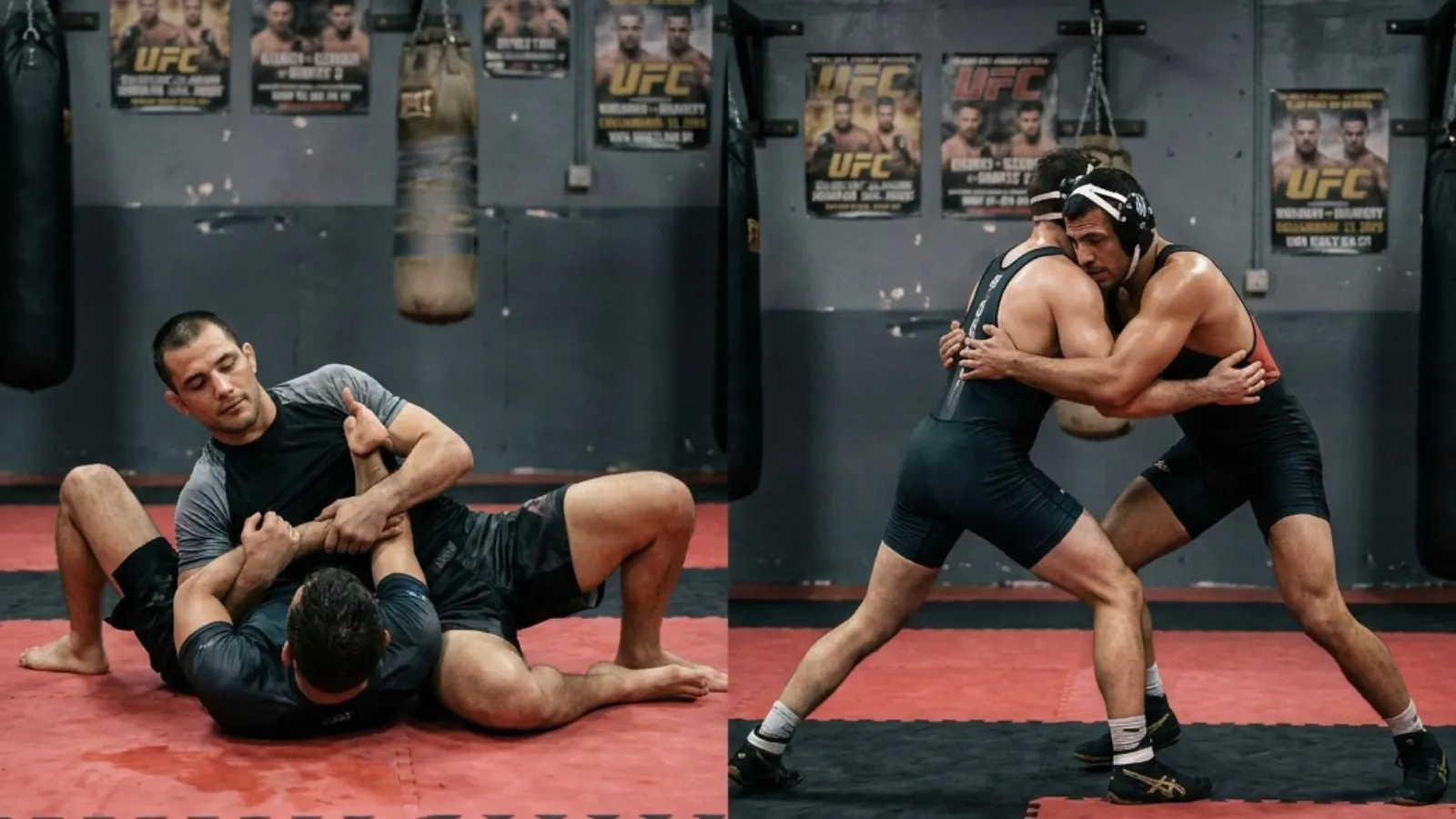
People ask me this one all the time, usually some version of "if I could only train one, should it be jiu-jitsu or wrestling?" I coach wrestling at our Ashburn academy and I train BJJ, so I get why it feels like picking a side. It isn't, really. They're both grappling, they overlap a lot, and the best grapplers I know steal from both. But they do reward different things, and if you're choosing where to start, the differences actually matter.
Short version: wrestling is about taking someone down and staying on top, and it will get you in shape faster than almost anything. BJJ is about controlling and submitting someone once the fight hits the ground, and it's kinder to your body and your ego over the long haul. Below is how they really differ, which is easier to pick up, which wins for self-defense and for MMA, and how I'd help you choose.
What is the real difference between BJJ and wrestling?
The simplest way to say it: wrestling decides who ends up on top, and jiu-jitsu decides what happens next. Wrestling is built around takedowns and pins. The whole sport is about getting your opponent to the ground and holding them there, and everything trains toward explosive, relentless movement. Brazilian jiu-jitsu assumes the fight is already on the ground and focuses on position and submissions, chokes and joint locks that end the match without a single strike. A wrestler wants to be on top and moving. A BJJ player is comfortable off their back, using their legs, patient, looking to trap a limb or the neck. Same starting point, grappling with no punches, but two very different games once you get past hello.
BJJ vs wrestling at a glance
Here's the honest side-by-side, the version I give parents and adults on the mat when they're trying to decide. Neither column is "better." They're built for different jobs.
| Brazilian jiu-jitsu | Wrestling | |
|---|---|---|
| Main goal | Control and submit on the ground | Take down and pin |
| Where the action is | Mostly on the ground | Standing into the ground |
| Ranked by | Belt system (years per belt) | No belts, ranked by competition |
| Learning curve | Slower, technical, less brutal early | Steep conditioning demand up front |
| Conditioning | Builds over time | Elite cardio, fast |
| Off your back | A strong position (guard) | A losing position, get up now |
| Injury risk | Lower, but finger and knee wear | Higher impact, more bruising |
| Best first for | Adults wanting a lifelong skill | Athletes wanting toughness fast |
Which is easier to learn as a beginner?
BJJ is usually the gentler on-ramp, but wrestling gives you a usable skill faster. In your first month of jiu-jitsu, nobody is slamming you and you can tap the moment something feels wrong, so the learning happens at a survivable pace. The trade is that it takes a while before the pieces click, and plenty of adults feel lost for the first couple of months. That's normal, everyone goes through it. Wrestling is more physically demanding out of the gate, the conditioning alone humbles most people, but the core idea, get the takedown and stay on top, is simple enough that you can use a little of it early. If you're worried about getting hurt or feeling out of shape, jiu-jitsu is the softer start. If you want to be gassed and sore and improving fast, wrestling delivers. We break down the very first session in our guide to what to expect at your first class, and both start the same way: slow, technical, no one trying to hurt you.
Which is better for self-defense?
For most everyday situations, jiu-jitsu is the more complete self-defense skill, but wrestling is what controls how the fight even starts. Here's the real trade. Wrestling wins the takedown battle. If someone grabs you or you get grabbed, a wrestler decides where that goes, and being able to put a bigger, aggressive person on the ground and stay on top is enormous. But wrestling has no finish. It controls, it doesn't end things. BJJ adds the part wrestling is missing, a way to actually neutralize the threat with a choke or a hold from positions where a wrestler would just be stalling. The most honest answer is that the combination is what you want, wrestling to dictate the takedown and stay on top, jiu-jitsu to end it safely. If you only get one, BJJ edges it for the average person because it works even when you end up on the bottom, which is exactly where untrained people panic. We go deeper on this in our breakdown of the best martial arts for self-defense.
Which is better for MMA?
You need both, and the top mixed martial artists train both, but wrestling is the more valuable base if you had to pick one. Wrestling decides where the fight takes place, and in a sport where you can also get punched, that's huge, the wrestler chooses to keep it standing or put it on the mat. That's why so many high-level MMA athletes come from a wrestling background. But wrestling alone leaves you exposed to submissions, and that's where a wrestler with no jiu-jitsu gets caught in an armbar or a choke they never saw. BJJ teaches you to attack from the bottom and to defend the finishes wrestling doesn't cover. At our gym the members who cross-train both are the ones who look the most complete when they roll. If MMA is your goal, start with whichever is available first and add the other, because you're going to need the whole picture. Our MMA vs boxing vs BJJ piece walks through how the pieces fit together.
Which is harder on your body?
Wrestling is the higher-impact sport, and jiu-jitsu is the one you can train into your fifties. Wrestling means a lot of driving, scrambling, and hitting the mat hard, so you feel it, bruises, sore neck, the occasional tweak, and it asks a lot of your conditioning every session. Jiu-jitsu is lower impact because so much of it happens on the ground at a controlled pace, and you can slow a roll down or tap early any time. It's not injury-free, fingers and knees take the most wear over the years, but it's far friendlier to an older body or someone easing back into training. This is a big reason we see adults in their forties and beyond stick with BJJ. If longevity matters to you, jiu-jitsu is the safer long game, and we cover it in depth in our guide to martial arts for seniors.
Can you (or your kid) train both?
Yes, and honestly it's the best path if you have the time, because each one covers the other's blind spot. Wrestling gives you takedowns and the toughness to fight when you're tired. BJJ gives you the submissions and the calm to work off your back. Trained together they make a grappler who's hard to take down and dangerous once it hits the ground. Plenty of our members roll BJJ a few days a week and drill wrestling on the others. For kids it's the same story, and wrestling in particular teaches a young athlete to be uncomfortable and keep going, which carries over everywhere. If you want the youth angle, we cover it in wrestling for kids and kids BJJ in Northern Virginia. You don't have to choose forever. A lot of people start with one and add the other once they're hooked.
Which should you start with in Northern Virginia?
Start with jiu-jitsu if you want a lifelong skill that's easy on your body, and lean wrestling if you want conditioning and toughness fast or you're aiming at MMA. If you're an adult who mostly cares about self-defense, fitness, and being able to train for years, BJJ is the friendlier place to begin, and you can add wrestling's takedowns later. If you're a competitor, a younger athlete, or someone who wants to build a serious base for mixed martial arts, wrestling is the harder, faster foundation and worth the early grind. At Kaizen we teach both across our Northern Virginia academies, and the real answer usually comes down to which class time fits your week and which room you walk out of wanting to come back to. The best way to know is to feel the difference yourself. Come try a free class, check the schedule, and see our BJJ and wrestling programs. If you're still deciding between grappling and striking altogether, start with Muay Thai vs BJJ. And once you pick jiu-jitsu, here's gi vs no-gi and which to start in.
Frequently asked questions
Is BJJ or wrestling better for a total beginner?
BJJ is the gentler start for most beginners because you train at a survivable pace and can tap out the moment something feels wrong. Wrestling is more physically demanding early but gives you a usable takedown skill faster. If you're worried about fitness or injury, begin with jiu-jitsu.
Can a wrestler beat a BJJ player?
It depends on where the match goes. A wrestler often controls the takedown and can stay on top, but a skilled BJJ player is dangerous off their back and can catch a wrestler in a submission. Neither wins automatically. It comes down to who is more experienced and where the grappling happens.
Do you need to be in shape to start wrestling?
No. Wrestling builds the conditioning for you, and every class is scalable so you go at your own pace and take water breaks whenever you need them. You'll be sore the first few weeks, then your body adapts. Getting in shape is what the training is for, not something you do beforehand.
Does BJJ use striking?
No. Brazilian jiu-jitsu is pure grappling, control, positions, and submissions like chokes and joint locks, with no punches or kicks. Wrestling is also strike-free. If you want striking too, that's where boxing, Muay Thai, or full MMA come in. We compare the two ranges head to head here.
Which is better for kids, wrestling or jiu-jitsu?
Both are great for kids and teach different lessons. BJJ suits kids who prefer problem-solving and don't love hard contact, while wrestling builds grit and comfort with being uncomfortable. Many of our young athletes do both. See our guides on kids BJJ and wrestling for kids.