
If you're looking at Brazilian jiu-jitsu for your kid, you've already done one thing most parents don't, which is look past karate as the default. The next honest question is whether BJJ is actually a good fit for your specific child, what a kids class looks like, and how it compares to the other martial arts your child could be doing instead.
After years of running kids BJJ across our gyms in Northern Virginia, the short version is that kids BJJ is the one martial art where a smaller child can control a bigger one without throwing a punch. That single fact does most of the work parents actually want martial arts to do, and it's why we'd recommend it first for most kids. Here's the full picture, the honest version, including where it's a great fit and where another art might suit your child better.
Quick answer: is kids BJJ a good fit for your child?
For most kids, yes. BJJ teaches grappling, ground control, and submissions with no punches and no kicks. A kid learns how to stay calm when someone bigger is on top of them, how to use leverage instead of strength, and how to keep their feet when grabbed. The class is built around drilling positions with a partner and slow live problem-solving, not striking and not contact to the head. It tends to fit calmer kids, anxious kids, smaller kids, and kids who don't like the idea of hitting people. It also fits kids with a ton of energy who need a constant physical puzzle to stay engaged. The kid it suits least is the one who specifically wants to punch and kick targets, in which case Muay Thai or kids kickboxing and boxing is the better starting point.
What makes BJJ different from other kids martial arts
The two things you need to know up front. First, there's no striking. Kids BJJ never trains punches or kicks. The whole art is grappling. Second, it's the one martial art designed around the smaller, weaker person beating the bigger, stronger one through leverage and position. That second fact is what makes it so useful for the average kid.
Most school scuffles aren't boxing matches. They're shoves, grabs, headlocks, a kid getting taken to the ground and pinned. A kid who has trained BJJ for six months has answers to all of those scenarios without ever throwing a punch. They know how to stay off their back, how to get back to their feet, how to control the position until they can walk away or an adult arrives. That's a different toolkit than what karate or pure striking would give them, and it's the toolkit that actually fits the situations kids run into.
What a kids BJJ class at Kaizen actually looks like
Here's the structure of a typical hour so the first session isn't a mystery.
- Bow-in and warm-up, 10 minutes. Kids line up, bow in with the coach, then run through movement drills on the mat. Shrimping, bridging, technical stand-ups, forward rolls. These are the foundational movements every position in BJJ uses, so we drill them every class.
- Technique, 15 to 20 minutes. The coach demonstrates one specific thing. An escape from a bad position. A simple sweep. A way to keep someone off you. The kids pair up and drill it slow with a partner, with a coach circulating to fix the details.
- Positional games, 15 to 20 minutes. This is the part kids love most. We start them in a specific position and they have a job to do. Try to escape this. Try to hold this. The first to lose the position resets. It's grappling presented as a game, which is exactly how kids learn fastest.
- Cool-down and bow-out, 5 to 10 minutes. A short cool-down, a quick reminder of the lesson, and a hand-slap and bow with everyone they drilled with. Then they're done.
No live free rolling for new kids. We add limited positional rolling as kids develop the basics, and it stays controlled. No slamming, no cranking submissions, no neck pressure. Kids tap their partner the moment something feels uncomfortable and the partner releases. That tap rule is drilled from class one, and it's the safety mechanism that makes BJJ one of the lower-injury martial arts for kids.
Why the no-striking rule matters more than most parents expect
This is the part that flips a lot of nervous parents into BJJ. A grappling class doesn't have your child training to hit anyone or be hit. There's no contact to the head and no impact on a growing brain. Concussion risk in BJJ is genuinely low compared with striking arts, contact football, or even soccer. The injuries that do happen in kids BJJ are usually minor strains or scrapes, the same as any active sport.
The deeper reason matters too. We don't want a 7-year-old learning to throw the first punch as their default tool. We want them learning to stay calm, control the situation, and not need to throw anything. The grappling-first approach is the way to teach that. A kid who's confident on the ground doesn't have to escalate. A kid whose only tool is a punch escalates by default. That's the difference parents notice over a year of training.
Age splits at Kaizen: Little Lions (4 to 7) vs Young Lions (8 to 12)
Kids classes split by age because a 5-year-old and an 11-year-old need different things. The split is real, not cosmetic.
| Program | Ages | What class actually focuses on |
|---|---|---|
| Little Lions | 4 to 7 | Coordination, listening, taking turns, basic body awareness, simple positions presented as games. The real curriculum is "can follow instructions and be part of a group," with BJJ as the vehicle. |
| Young Lions | 8 to 12 | Real technique. Kids learn specific BJJ positions, escapes, basic submissions (taught with control, no cranking), and start to develop a game. Positional games get harder. Some controlled live rolling starts here. |
For most kids 4 to 6, the win in the first six months isn't a fancy submission. It's that they can take instruction from an adult who isn't their parent, stand still for the bow-in, and partner with another kid without melting down. The BJJ technique comes second to that foundation. We expect this and we build the class around it.
For the 8-to-12 group, the technique gets real. By 6 months in, a Young Lion can recognize half a dozen positions by name, escape side control, sweep from guard, and tap a friend with a basic submission they actually understand. The skill compounds fast in this age band.
The kids belt path: what stripes and belts actually mean
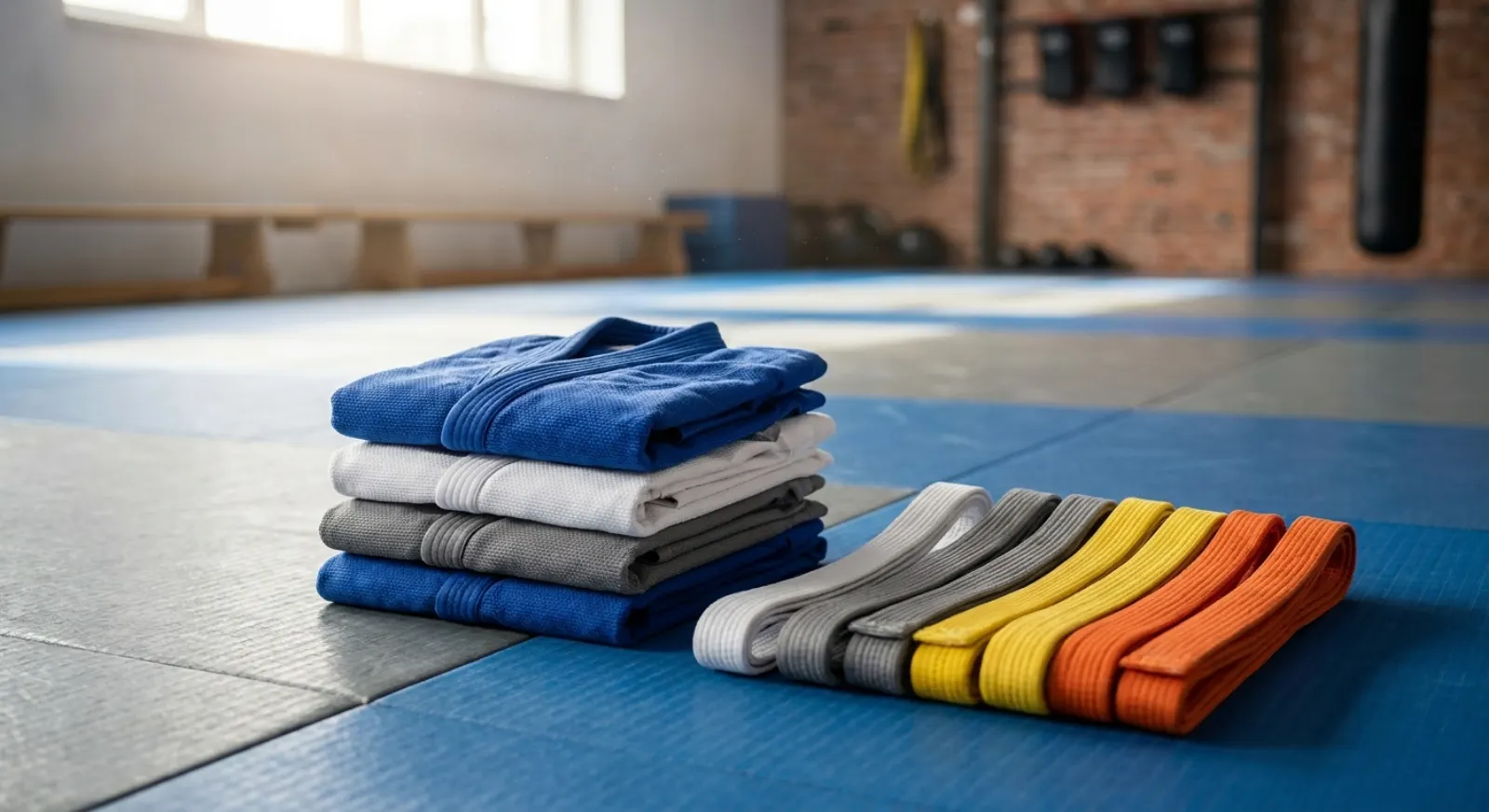
Kids BJJ uses a different belt system from adults. The progression for kids under 16 is white, gray, yellow, orange, green, with stripes between each belt. The IBJJF (International Brazilian Jiu-Jitsu Federation) sets these standards, and Kaizen follows them honestly. The reason this matters: some kids martial arts programs hand out belts every 8 weeks to keep parents paying. Real BJJ doesn't work that way.
Stripes typically come every 4 to 6 months for an engaged kid training twice a week. A new belt color usually takes 1.5 to 3 years. We don't promise specific timelines because every kid is different. What we do promise is that a stripe means the kid actually earned it. A kid who gets handed belts they didn't earn loses trust in the system. A kid who earns one carries it differently. That's the version of belt progression we run. When they turn 16 those kids belts convert into the adult ranks, which we lay out in full in our guide to BJJ belt levels.
Kids BJJ vs other martial arts: the honest parent comparison
| What you care about | Kids BJJ | Karate or pure striking | Wrestling |
|---|---|---|---|
| Self-defense for a smaller kid | Strongest. Leverage and position beat size. | Mixed. A small kid throwing punches loses to a bigger kid throwing punches. | Very strong. Similar reasoning. |
| Injury risk | Low. No head contact. Tap-out culture. | Moderate. Head contact in sparring depending on the school. | Low to moderate. Joint and neck care matters. |
| Discipline and respect | Strong. Built into class structure. | Strong. Often the most ceremonial. | Strong. Hard-work culture. |
| Confidence build | Strong. Real problem-solving wins. | Strong. Belt path and forms. | Strong. Pushing through hard rounds. |
| Cardio and fitness | Good. Mostly aerobic effort. | Good. Often more anaerobic. | Excellent. The conditioning leader. |
| Fit for a calmer or anxious kid | Excellent. No striking, slow problem-solving pace. | Mixed. Loud kihaps and pad strikes can overwhelm. | Good if the coach is gentle. Demanding otherwise. |
| Fit for a high-energy kid | Excellent. Constant physical puzzle. | Good. Hitting pads burns energy. | Excellent. Constant movement. |
If your child is a smaller kid, a calmer kid, or a kid you'd describe as anxious or nervous about contact, BJJ is the cleanest first martial art. If your kid is dying to punch and kick things, start with striking and add BJJ later. If your kid wants to compete physically and grind, wrestling is excellent. There's no wrong answer among these three. There are just better and worse fits for the specific child.
For a deeper comparison across all the kids martial arts options, see our take on the best martial arts for kids, and if you typed "karate" into Google to get here, read our honest karate-for-kids reframe first.
What we coach against: the rough kid, the showoff, the bully drift
BJJ has a culture problem that some gyms tolerate and we don't. A kid who learns how to control bigger people can drift in two bad directions. They can start showing off, putting submissions on friends outside class, or talking about beating people up. Or they can drift toward using their training to feel powerful in a way that crosses into bullying.
We watch for this hard. A kid showing off submissions on a sibling gets pulled aside the same week. A kid who escalates in class gets paired with a coach until they reset, and we call the parents. The whole reason the martial arts tradition has a strong emphasis on respect, restraint, and not using your training is to stop exactly this drift. We coach against it on purpose, and most kids never go near that drift in the first place. But if your child has shown signs of escalating with siblings or other kids at school, tell us at intake. We'll coach them differently than the kid who flinches and shrinks.
Where we teach kids BJJ in Northern Virginia
Kaizen runs kids martial arts across Northern Virginia, including Falls Church, Fairfax, Vienna, Ashburn, and Purcellville. Each location runs age-split Little Lions and Young Lions classes built around Brazilian jiu-jitsu, wrestling, and Muay Thai. BJJ is the foundation of the mix because of everything in this piece. Schedules vary by location, so the simplest next step is a free kids trial at the location closest to you. Sit on the side, watch one class, and judge it for your specific kid.
If you want more reading first, see how a good kids program builds discipline and focus, builds the confident kid without the aggressive kid, what we see with kids with ADHD on the mat, and what age a kid should start. If you're curious about BJJ for yourself as well, the adult BJJ beginner walkthrough covers the equivalent for grown-ups.
Frequently asked questions about kids BJJ
Is BJJ safe for kids?
Yes, when it's coached right. Kids BJJ has lower injury rates than most contact sports, including soccer and football, because there's no head contact, no striking, and the tap-out culture is drilled from day one. The injuries that do happen are usually minor strains or scrapes. If you've ever worried about concussion risk in youth sports, the no-head-contact aspect of BJJ is one of the strongest things going for it.
At what age can a kid start BJJ?
Our Little Lions program runs from ages 4 to 7. For BJJ specifically, somewhere between 5 and 7 tends to be an easy on-ramp because the kid can follow a short instruction and stay with a partner for a 60-second rep. Ages 8 to 12 start in Young Lions, and teens 13 and up start in the adult program. Starting later is not a problem.
Will my kid get hurt rolling with bigger kids?
Kids are paired by size and experience, not at random. A new white belt 5-year-old doesn't get put against a 12-year-old with two years of training. We watch pairings constantly and switch partners if anything looks off. The tap-out rule means the moment something feels uncomfortable, your kid taps, the partner releases, and the round resets. Coaches reinforce that rule every class. The injury risk that scares parents is real in some gyms with bad culture and very low at gyms where it's coached right.
What does my kid need to wear?
For the first class, athletic shorts and a t-shirt. We loan a gi (the white uniform) so you don't have to buy one before knowing the kid will stick with it. After the first month, you'll want your own kids gi. We can point you to inexpensive options. No special shoes. Kids train barefoot on the mat.
How often should my kid train?
Twice a week is the sweet spot for most kids. Once a week is enough to slowly build skills, twice gets real progress, three times is for kids who genuinely love it and want to compete. Don't push for more than your kid is asking for. The kids who stay in BJJ for years are the ones who chose to come back, not the ones who were forced into a third class a week.
Will my kid have to compete?
No. Competition is optional and we don't push kids into it. About one in five kids in our program competes at all. The ones who do usually choose it themselves after a year or two of training and ask to do a local tournament. The other four are just there for the training, and they progress through belts at the same pace as the competitors.
How is kids BJJ different from adult BJJ?
Lower intensity, simpler techniques, more positional games and less live rolling, no submissions that crank joints, smaller class sizes for the youngest age groups, and a different belt system (white, gray, yellow, orange, green for kids under 16). The fundamentals are the same. A kid who trains BJJ from age 6 to 16 has a serious skill base by the time they age into the adult belt system at white belt.
Is BJJ better than karate for my kid?
For most kids, yes, for the reasons in this piece. A small kid throwing punches loses to a bigger kid throwing punches. A small kid who knows leverage and position can control a bigger kid without striking. If your heart is set on traditional karate, a dedicated karate dojo is the right call and we'll happily tell you that. For most other goals parents have, BJJ does the job better. See our karate vs jiu-jitsu comparison for the longer version.
My kid is shy and doesn't like contact. Will BJJ work?
Often yes, because the contact in BJJ is closer to a wrestling hug than a punch. Shy kids tend to do well in BJJ because the class structure is predictable, partners stay constant for a drill, and there's no loud striking or yelling. Many of our most confident BJJ students were the kids hiding behind a parent at intake. Tell us at intake your kid is on the shy side. We'll pair them gently and let them watch a class before joining if that helps.